What Is BNPL? A Complete Guide to Buy Now Pay Later in India


A major purchase often comes with a familiar dilemma: pay the entire amount today, postpone the purchase, or look for a way to spread the cost over time. Buy Now Pay Later (BNPL) and EMI financing are designed to address this moment in the purchase journey. They allow eligible customers to access a product or service now and repay the financed amount according to an agreed schedule.
In India, the conversation around BNPL is closely connected to the expansion of digital payments, the growth of online commerce and the wider availability of credit through banks and non-banking financial companies (NBFCs). But BNPL is not simply a button at checkout. It is a financing arrangement with eligibility checks, lender terms, repayment obligations and consumer protections. Understanding those details helps customers make better decisions and helps businesses choose the right BNPL platform.
What does BNPL mean?
BNPL stands for Buy Now Pay Later. In a typical arrangement, a customer chooses a product or service, selects an available financing option and completes an eligibility process. If approved by the lender, the purchase is completed and the customer repays the financed amount over a defined period. Depending on the product, the repayment may be a short-term instalment, a fixed-tenure EMI or another agreed schedule.
The term BNPL is used broadly in the market. Some providers offer short-duration deferred payment products; others facilitate longer-tenure instalment loans at checkout. The underlying lender, cost of credit, repayment schedule and customer eligibility can therefore differ significantly. A responsible BNPL explanation should always make these distinctions clear.
How does Buy Now Pay Later work?
The customer selects a product or service from a participating merchant.
At checkout, the customer chooses an available BNPL or EMI option.
The customer provides the information required for an eligibility assessment and reviews the relevant disclosures.
A participating bank or NBFC evaluates the application and determines whether an offer can be made.
If an offer is approved, the customer reviews the amount, tenure, interest, fees and repayment schedule before accepting.
The transaction is completed according to the merchant and lender process. The customer then repays the lender as agreed.
The lender's approval is not automatic. It may depend on credit profile, income or other underwriting factors, product eligibility, transaction value and the lender's own policies. An EMI option displayed to one customer may not be available to another.
Why BNPL is relevant in India's digital economy
India's digital payment infrastructure has grown at extraordinary scale. The Reserve Bank of India's analysis of digital payments reports that UPI processed 18,586 crore transactions worth approximately ₹261 lakh crore in FY 2024–25. UPI represented 84% of digital payment transaction volume that year. This is evidence of how familiar digital checkout and account-to-account payments have become—not proof that BNPL itself has grown at the same rate, but an important foundation for digital financial experiences.
A separate Ministry of Finance release reported 22,167.90 crore retail digital payment transactions worth ₹849.12 lakh crore in FY 2024–25, with UPI accounting for 81% of retail digital payment transactions. The figures use a different retail digital payment measure from the RBI bulletin's UPI table, so they should not be combined. Together, they show the scale and normalisation of digital transactions in India.
Credit is also an important part of household financial activity. The RBI's Financial Stability Report published in December 2025 noted that non-housing retail loans—largely loans for consumption—accounted for 55.3% of household borrowing from financial institutions as of September 2025. This is a reminder that access to credit comes with responsibility: a financing option should be evaluated against a customer's existing obligations and ability to repay.
Indicator | Reported figure | What it tells us |
UPI transactions, FY 2024–25 | 18,586 crore | Digital payments are used at national scale. |
UPI transaction value, FY 2024–25 | About ₹261 lakh crore | UPI supports substantial transaction value across use cases. |
UPI share of digital payment volume, FY 2024–25 | 84% | UPI is a major part of India's digital payment mix. |
Non-housing retail loans as share of household borrowing, Sep 2025 | 55.3% | Consumption-related credit is a significant part of formal household borrowing. |
BNPL, credit-card EMI and personal loans: what is the difference?
These products can all help finance a purchase, but they are not interchangeable. Credit-card EMI generally converts an eligible card transaction into instalments under the card issuer's terms. A personal loan is a separate loan that may be disbursed to the borrower and can be used for a broader purpose. BNPL is a checkout-oriented label that may refer to different lender-backed structures, including short-term pay-later products or instalment loans.
Feature | BNPL / checkout EMI | Credit-card EMI | Personal loan |
Where it is initiated | At a participating merchant or checkout | On an eligible credit-card transaction | Through a lender's loan application |
Credit card required | Not always; depends on the option | Yes | Usually no |
Use of funds | Usually tied to the eligible purchase | Tied to the card transaction | Often broader, subject to loan terms |
Pricing | May include interest, fees or a promotional offer | Depends on issuer, tenure and offer | Depends on lender, APR, fees and tenure |
Approval | Subject to lender assessment | Subject to card and transaction eligibility | Subject to lender underwriting |
Customers should compare the total amount payable rather than judging a product by the size of the monthly instalment alone. A lower EMI can simply mean a longer tenure and a higher overall cost.
A practical EMI example
Assume a customer finances a purchase of ₹30,000 for 6 months at a hypothetical reducing-balance annual interest rate of 18%, with no processing fee. The approximate EMI would be ₹5,263 and the total repayment about ₹31,578. This is an illustration only. Actual instalments can differ because lenders may use different rates, fee structures, repayment dates and calculation methods. The customer should rely on the lender's Key Facts Statement and final repayment schedule.
Benefits and considerations for customers
A well-designed BNPL option can help a customer manage a planned expense without paying the full amount on the day of purchase. It may provide a convenient digital application, a choice of eligible lender offers and repayment dates that are easier to plan around. For certain high-value services—such as healthcare, travel, insurance or education—the option to pay over time may help customers evaluate a purchase that would otherwise create a large immediate cash outflow.
However, financing does not make a purchase cheaper by itself. Before accepting an offer, check the annual percentage rate (APR), processing fee, GST on applicable fees, late-payment charges, foreclosure or prepayment terms, repayment date, credit-bureau reporting and consequences of missed payments. Do not borrow simply because an offer is available. The instalment should fit comfortably within the household budget after essential expenses and existing EMIs.
What should customers know about digital lending rules?
The Reserve Bank of India issued the Digital Lending Directions, 2025 on 8 May 2025. These directions apply to digital lending activities of regulated entities, including banks and NBFCs, and address lender–Lending Service Provider arrangements, creditworthiness assessment, disclosures, disbursal and repayment, cooling-off periods, grievance redressal and data practices. Customers should identify the actual regulated lender, read the loan disclosures and use the lender's official grievance channels if an issue arises.
A key practical point is that the customer should be able to understand who is lending, how much is being borrowed, what it costs and how repayment works. The platform facilitating the customer journey should not obscure the identity or responsibilities of the regulated lender.
How BNPL can help businesses
For a merchant, affordability is part of the buying decision. A customer may want a treatment, holiday, insurance policy or professional course but hesitate when the entire price is due immediately. Offering an appropriate EMI option can give that customer another way to complete the purchase. It can also help a business explain the cost in monthly terms, make higher-value packages easier to evaluate and provide an additional payment choice at checkout.
ShopSe's approach to affordability in digital payments is also discussed in a Moneycontrol article, “Why Every Payment Aggregator Will Eventually Need an Affordability Layer Like ShopSe”, which looks at embedded affordability as digital payments mature.
These are commercial opportunities, not guaranteed outcomes. A business should measure conversion rate, average order value (AOV), BNPL selection, lender approval, cancellations, refunds, payment reconciliation and contribution margin before deciding whether a financing programme is successful.
How ShopSe supports EMI financing
ShopSe is a digital EMI financing platform that helps participating businesses offer customers multiple financing routes. Its solution set includes Pre-approved EMI, Credit Card EMI and an NBFC Marketplace. Through a single form, customers can check for eligible offers from multiple lending partners, subject to lender participation, underwriting and transaction eligibility.
The platform is relevant across Health & Wellness, Travel, Insurance and Education, where customers may face meaningful upfront costs. ShopSe's role is to facilitate access to financing options offered by lending partners; it should not be confused with the regulated lender or represented as guaranteeing approval, a particular interest rate or a zero-cost loan.
LiveMint has also featured ShopSe's approach to expanding access to formal credit in “Meet ShopSe: The Mumbai Startup Introducing Formal Credit to India's Next 25 Crore Credit Consumers”, which describes ShopSe's aim of making financing options visible at the point of purchase through banks and NBFCs.
The future of BNPL in India
The next phase of BNPL will depend on more than convenient checkout design. Trust, transparent pricing, responsible underwriting, data protection, effective grievance handling and reliable merchant integration will matter just as much. Businesses will need to choose platforms that make the customer journey clear and provide useful operational reporting. Customers will need to compare total repayment obligations and avoid taking on more debt than they can manage.
Ultimately, a good BNPL experience is one in which the customer understands the financing, the merchant can serve an eligible buyer more effectively and the lender has assessed the risk responsibly.
Explore ShopSe's EMI financing solutions to understand how businesses can make eligible products and services more accessible through flexible payment options: https://www.getshopse.com/
Frequently asked questions
What is BNPL?
BNPL means Buy Now Pay Later. It is a checkout financing arrangement that allows an eligible customer to complete a purchase and repay the financed amount later or in instalments under lender terms.
How does Buy Now Pay Later work in India?
At an eligible checkout, the customer selects a financing option, completes the required application and reviews the lender's offer. If approved and accepted, the purchase is completed and repayments follow the agreed schedule.
Is BNPL the same as a credit card?
No. BNPL may be offered through a bank or NBFC-backed checkout loan or another pay-later structure. Credit cards are revolving credit products issued under separate terms.
Can I use BNPL without a credit card?
Some cardless EMI and lender-backed options do not require a credit card. Availability depends on the merchant, lender and customer's eligibility.
Does BNPL charge interest?
It may. Some offers may have promotional pricing, while others charge interest and/or fees. Always review the APR and total amount payable.
Does BNPL affect my credit score?
A lender may report the loan or repayment behaviour to credit information companies. The impact depends on the lender's reporting and the customer's repayment history.
Is BNPL safe?
It can be used responsibly when the regulated lender is identifiable, disclosures are clear, data is handled appropriately and the customer understands repayment obligations.
Where can I use Buy Now Pay Later?
Only at merchants and for transactions where the relevant lender-backed financing option is available and the customer meets eligibility requirements.
Sources and further reading
RBI Bulletin, Trends in Digital Payments (FY 2024–25 UPI data) — https://www.rbi.org.in/scripts/BS_ViewBulletin.aspx?Id=23646
PIB / Ministry of Finance, Coordinated Efforts of Government, RBI and NPCI Accelerate Growth in Digital Payments, 16 March 2026 — https://www.pib.gov.in/PressReleasePage.aspx?PRID=2240723&lang=2®=48
RBI, Financial Stability Report, December 2025 (household borrowing) — https://www.rbi.org.in/Scripts/PublicationReportDetails.aspx?ID=1313
RBI, Digital Lending Directions, 2025, 8 May 2025 — https://www.rbi.org.in/scripts/FS_Notification.aspx?Id=12848
Related reading
Travel loan options: how Buy Now Pay Later makes travel more affordable
BNPL for healthcare: how Buy Now Pay Later makes treatment more affordable
How BNPL and EMI financing make insurance premium payments easier
Explore ShopSe's financing solutions: Education financing options | Travel financing solutions | Checkout financing solutions | Offer Buy Now Pay Later to your customers
Related reads
Understanding Premium Financing Platforms in India: A 2026 Guide for Insurance Companies
A comprehensive guide for insurers evaluating premium financing platforms in India, covering financing models, approval structures, and how centralized platforms improve insurance conversions.
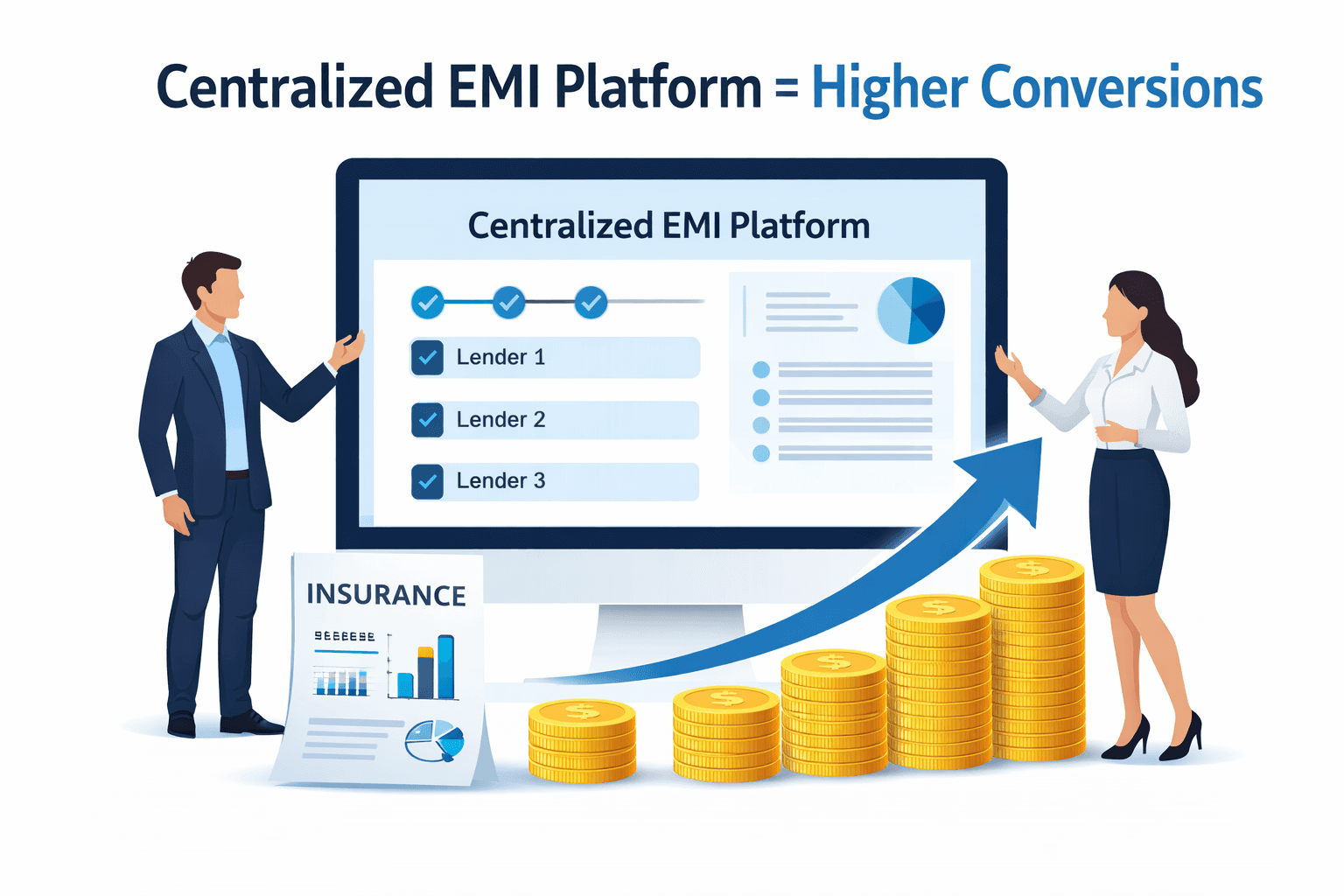
How a Single EMI Platform Helps Insurance Sales Managers Improve Conversions and Reduce Policy Drop-Off
Discover how a centralized EMI platform with multiple payment options helps insurance sales managers increase policy conversions, reduce drop-offs, and accelerate team target achievement.
Single NBFC vs Multi-Lender EMI for Insurance: What Sales Heads Should Know
Explore the difference between single NBFC and multi-lender EMI models for insurance premium financing in India and how lender architecture impacts approval rates and policy conversion.

How Businesses Can Sell Products and Services on BNPL to Increase Sales and Conversions
Learn how businesses can offer Buy Now Pay Later and EMI financing to customers. Explore benefits, industry use cases, implementation steps and key metrics.