How BNPL and EMI Financing Make Insurance Premium Payments Easier


Insurance is designed to protect households and businesses from financial shocks. Yet the premium itself is a payment that must fit into a household budget. When a family reviews health insurance, a customer renews a policy or a business evaluates coverage, the amount due can influence the decision. For eligible customers, insurance premium financing and EMI options may provide another way to manage the payment.
Financing does not make insurance free and does not replace the policy contract. It creates a separate repayment obligation. Customers should understand both documents: the insurance policy and the loan or EMI agreement. They should also confirm when cover begins, how cancellations are handled and whether a refund will automatically reduce the loan balance.
India's insurance market: scale and the protection challenge
The Government of India's 2024–25 insurance sector review reported that the industry issued 41.84 crore policies and collected premiums of ₹11.93 lakh crore during FY 2024–25. The sector paid claims of ₹8.36 lakh crore and had assets under management of ₹74.44 lakh crore as of 31 March 2025. The same review placed India as the 10th largest insurance market globally by nominal premium volume, with a 1.8% global market share according to Swiss Re.
Despite this scale, insurance penetration remained at 3.7% in FY 2024–25: 2.7% for life insurance and 1.0% for non-life insurance. Insurance density increased from US$95 in FY 2023–24 to US$97 in FY 2024–25. Penetration measures premiums as a share of GDP; density measures premiums per person. Neither metric should be confused with the percentage of people who have a particular insurance policy.
Insurance sector indicator | FY 2024–25 figure |
Total policies issued | 41.84 crore |
Total premiums collected | ₹11.93 lakh crore |
Claims paid | ₹8.36 lakh crore |
Assets under management as at 31 March 2025 | ₹74.44 lakh crore |
Overall insurance penetration | 3.7% |
Life insurance penetration | 2.7% |
Non-life insurance penetration | 1.0% |
Insurance density | US$97 |
The figures show a large and active insurance market, but penetration is a macro-level measure and does not identify the reasons an individual household remains uninsured or underinsured. Affordability is one factor among several, alongside awareness, product suitability, trust, distribution and the ability to understand policy terms.
Why premium affordability matters
A household may need to evaluate health insurance for multiple family members, a separate policy for parents, life cover, motor insurance and other protection products. Premiums can cluster around the same time of year. A customer may also compare a higher sum insured, add-ons or a different policy structure. The decision should begin with the protection need and policy suitability—not with the monthly instalment.
The customer should compare coverage, exclusions, waiting periods, co-payments, room-rent limits, deductibles, sub-limits, claim procedures and renewal conditions. A cheaper premium is not necessarily better if the policy does not meet the household's needs. Likewise, financing should not be used to justify buying a policy that the customer cannot afford to maintain.
What is insurance premium financing?
Insurance premium financing refers broadly to using a credit facility or instalment arrangement to pay an insurance premium. Depending on the insurer, distributor and financing partner, customers may encounter insurer-provided instalment options, credit-card EMI or a lender-backed loan used to complete an eligible premium payment. These structures have different legal and operational characteristics.
A third-party lender-backed EMI is not the same as an insurer allowing the premium to be paid in instalments under the policy. The customer should check who is the creditor, who receives the premium, whether the policy is issued immediately, and what happens if the policy is cancelled or the premium is refunded.
How does BNPL for insurance work?
The customer chooses an eligible insurance product and reviews the policy details, premium and coverage.
At the supported payment stage, the customer selects an available EMI or financing option.
The customer completes the required eligibility process with the participating lender.
The lender assesses the application and may present a financing offer.
The customer reviews the APR, fees, tenure, EMI, total repayment and policy issuance conditions.
After acceptance, the premium payment and policy issuance proceed according to the insurer, platform and lender process.
Illustrative example: a ₹30,000 health insurance premium
Assume a family health insurance premium of ₹30,000 is eligible for a 6-month loan at a hypothetical reducing-balance annual interest rate of 18%, with no processing fee. The approximate EMI would be ₹5,263, and the total repayment would be approximately ₹31,578. This is only a mathematical illustration, not an available ShopSe or insurer offer. Actual lender terms may include interest, processing charges, GST on applicable fees and different repayment dates.
Illustrative financing detail | Assumption |
Premium financed | ₹30,000 |
Tenure | 6 months |
Illustrative annual reducing-balance rate | 18% |
Approximate EMI | ₹5,263 |
Approximate total repayment | ₹31,578 |
The policyholder should compare the financing cost with the benefit of paying the premium through that route. The monthly EMI is a loan repayment; it is not an additional insurance premium and it does not change the policy's coverage terms.
BNPL vs credit-card EMI for insurance premiums
Consideration | Lender-backed BNPL / EMI | Credit-card EMI |
Card requirement | May be cardless, depending on product | Requires an eligible credit card |
Eligibility | Assessed by participating lender | Depends on card limit, issuer rules and transaction eligibility |
Pricing | Lender-specific APR and fees | Issuer-specific interest and fees |
Repayment | As per loan agreement | As per card issuer's EMI schedule |
Key check | Lender identity, KFS and policy issuance | Card statement, EMI conversion terms and policy issuance |
What customers must verify before financing a premium
Insurance and loan contracts should be reviewed together. Customers should verify whether the policy becomes active only after the premium is successfully received, whether any underwriting or medical review remains outstanding, and what date appears as the policy commencement date. They should also check whether the premium payment is refundable, what proportion may be refunded after cancellation and how the refund will be allocated against the outstanding loan.
The customer should not assume that cancelling a policy automatically cancels the financing. A refund may take time, may be subject to deductions or may be routed according to the insurer and lender's process. Until the lender confirms the loan has been adjusted or closed, the customer should follow the repayment instructions and contact the lender if a payment is due.
How insurance businesses can benefit from EMI financing
For insurers, brokers, distributors and agents, a flexible payment option can help address a practical point of friction during purchase: the upfront premium. It may make it easier for an eligible customer to consider an appropriate policy, compare options and complete a purchase without relying solely on a single payment method. It can also give agents a more structured way to explain the payment journey.
The opportunity is not to push customers towards larger policies or additional borrowing. It is to make payment choices more transparent. Insurance businesses should train teams to explain the difference between premium and loan repayment, disclose lender terms accurately and avoid suggesting that financing changes policy coverage.
Useful metrics include quote-to-policy conversion, financing option selection, application completion, lender approval, policy issuance, cancellation, refund turnaround, renewal behaviour and customer complaints. Any improvement should be evaluated against the cost of financing, customer outcomes and the quality of policies sold.
How ShopSe supports insurance premium financing
ShopSe helps participating insurance businesses offer multiple EMI financing options, including Pre-approved EMI, Credit Card EMI and an NBFC Marketplace. Through one form, customers can check for available offers from multiple lending partners, subject to lender participation, eligibility and the supported insurance transaction.
This multi-option approach can help create a more structured customer journey for insurers, brokers, distributors and agents. The customer can review the offers that are actually available, while the lender remains responsible for underwriting and the credit facility. ShopSe facilitates the financing experience; it is not the insurer and should not be described as the direct lender.
For insurance businesses evaluating a BNPL solution, the key questions are whether the payment journey is clear, whether policy issuance and refund processes are understood, whether the lender terms are transparent and whether the solution integrates reliably with existing distribution workflows.
Discover ShopSe's EMI financing solutions for insurance businesses: https://www.getshopse.com/
Frequently asked questions
Can I pay my health insurance premium in EMI?
Some insurers, distributors or checkout journeys may support EMI through a card issuer or participating lender. Availability and terms vary.
What is insurance premium financing?
It is an arrangement that allows a premium to be paid using a credit facility or instalment option. The exact structure depends on the insurer and lender.
Can I buy life insurance using BNPL?
Only where the specific insurer, payment channel and lender support the transaction and the customer is eligible. Confirm policy issuance conditions before accepting.
Is insurance EMI available without a credit card?
Some lender-backed cardless options may be available, subject to the insurer, merchant, lender and customer's eligibility.
Does BNPL for insurance involve interest?
It may. Check the APR, processing fee, applicable taxes, late charges and total repayment.
Does financing an insurance premium affect my credit score?
A lender may report the credit facility and repayment behaviour to credit information companies. Ask the lender how the product is reported.
What happens if I cancel an insurance policy purchased using EMI?
The insurer's cancellation and refund terms and the lender's loan agreement determine the outcome. Contact both parties and obtain confirmation of the loan adjustment or closure.
Does EMI change my insurance coverage?
No. Coverage is determined by the policy contract. Financing changes how the premium is paid, not the benefits, exclusions or terms of the policy.
Sources and further reading
PIB, Insurance Sector Performance, FY 2024–25 — https://www.pib.gov.in/PressNoteDetails.aspx?ModuleId=3&NoteId=158322&id=158322&lang=1®=36
RBI, Report on Trend and Progress of Banking in India 2024–25 (insurance penetration and density table) — https://www.rbi.org.in/Scripts/PublicationReportDetails.aspx?ID=1314&UrlPage=
IRDAI, Handbook on Indian Insurance Statistics 2024–25 — https://irdai.gov.in/handbook-of-indian-insurance
RBI, Digital Lending Directions, 2025 — https://www.rbi.org.in/scripts/FS_Notification.aspx?Id=12848
Related reading
How Buy Now Pay Later works: a complete guide to BNPL in India
How to Pay Insurance Premium on EMI: A Guide for Agency Heads
How EMI for Insurance Premium Can Make Policy Renewals Easier for Agents and Customers
How Insurance Agents Can offer Loan for Health Insurance Premiums and Close More Sales
Explore ShopSe's financing solutions: Insurance premium financing solutions | Offer flexible EMI payment options
Related reads

What Is BNPL? A Complete Guide to Buy Now Pay Later in India
Understand what BNPL means, how Buy Now Pay Later works in India, its benefits, costs, risks and how customers and businesses can use EMI financing responsibly.
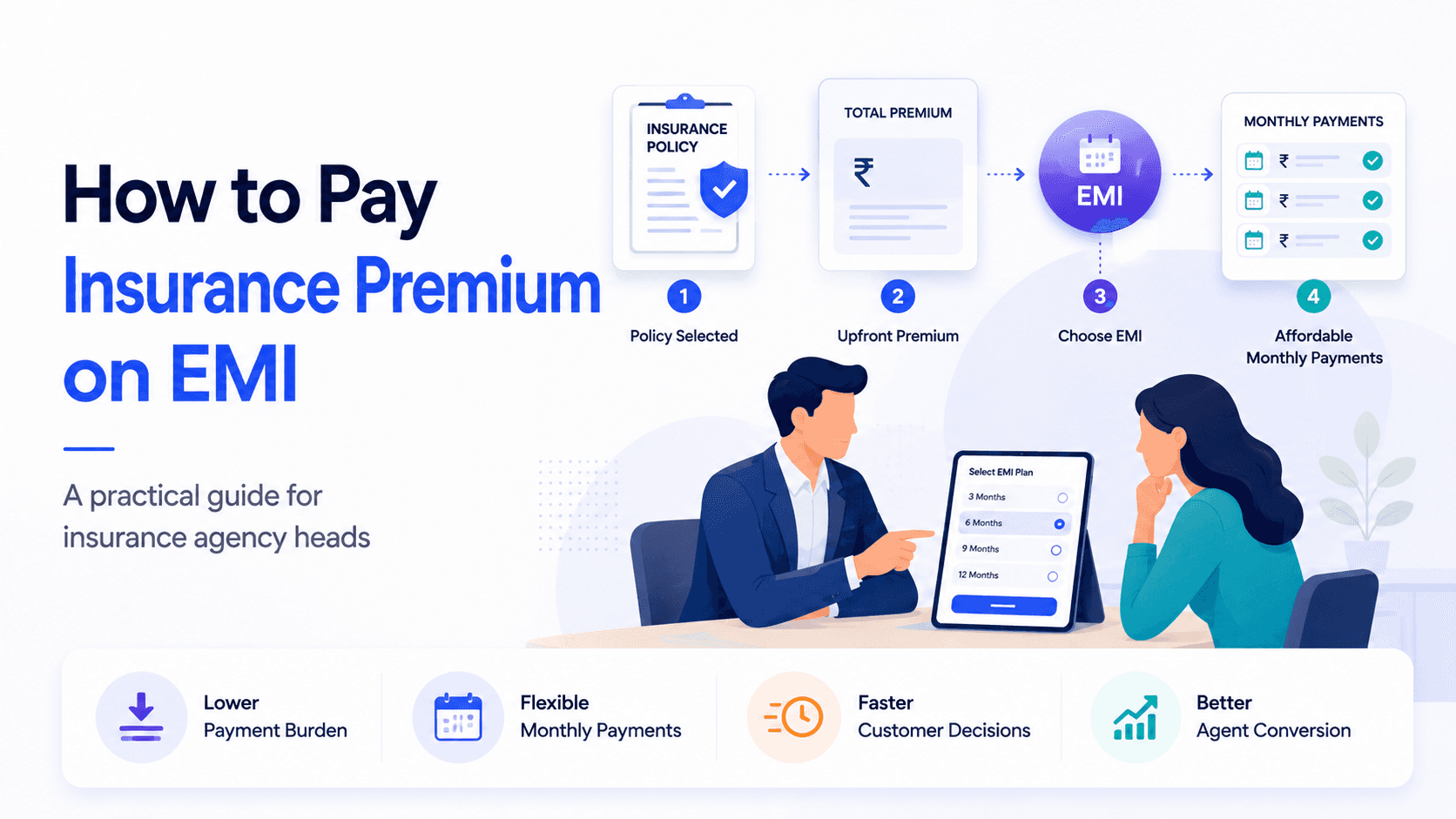
How to Pay Insurance Premium on EMI: A Guide for Agency Heads
A clear guide for insurance customers on how to pay insurance premium on EMI, written for insurance agency and distribution leaders looking to reduce affordability friction and improve agent conversion.

How EMI for Insurance Premium Can Make Policy Renewals Easier for Agents and Customers
Discover how EMI for insurance premium can help agents address affordability concerns, reduce payment friction and make health and life insurance renewals easier for customers.

How Insurance Agents Can offer Loan for Health Insurance Premiums and Close More Sales
Learn how insurance agents can use premium financing to overcome affordability objections, access multiple banks and NBFCs, and potentially increase health insurance policy sales.