How a Single EMI Platform Helps Insurance Sales Managers Improve Conversions and Reduce Policy Drop-Off

Insurance sales teams rarely lose customers because of lack of interest.
In many cases, customers understand the need for insurance, agree on coverage, and complete proposal formalities successfully.
Yet a significant number of policies fail to convert at the final stage.
Payment.
For sales managers responsible for achieving monthly and quarterly targets, this stage often becomes the most unpredictable part of the sales journey.
Customers who were ready to buy suddenly delay decisions, abandon applications, or request follow-ups. Agents revisit the same cases repeatedly, and conversion timelines extend beyond expectation.
A growing contributor to this problem lies in how EMI payment options are offered to customers.
The Reality of EMI-Based Insurance Sales Today
EMI availability has become an important affordability tool in insurance distribution.
Customers increasingly expect flexibility similar to other financial purchases, where payments can be spread across manageable monthly installments.
However, in many insurance sales environments, EMI enablement introduces a new layer of friction.
Different lenders require different application processes.
Customers are often asked to:
Fill separate forms for separate EMI providers
Submit details multiple times
Repeat verification steps
Restart applications if eligibility fails
Instead of simplifying payment, the process becomes fragmented.
From a customer’s perspective, this creates confusion and fatigue precisely when purchase intent is highest.
Why Multiple EMI Forms Reduce Conversion
Sales momentum depends on simplicity.
When customers must complete multiple financing applications to explore EMI eligibility, decision confidence weakens.
Each additional form introduces delay.
Each delay creates reconsideration.
Customers begin questioning whether the purchase should be postponed altogether.
For sales teams, this leads to familiar outcomes:
Pending proposals
Incomplete payments
Follow-up dependency
Month-end closure pressure
The issue is not EMI availability itself.
It is the absence of a unified payment experience.
The Sales Manager’s Challenge: Maintaining Momentum
Insurance sales managers constantly work to maintain pipeline velocity.
Agents perform best when conversations move smoothly from need identification to policy issuance.
Fragmented EMI processes interrupt this flow.
If one lender rejects an application, agents must restart with another option. Customers repeat data entry, increasing frustration and reducing trust.
In many cases, customers simply disengage.
Drop-offs occur not because the customer cannot afford the premium, but because the process feels complicated.
Conversion loss becomes operational rather than commercial.
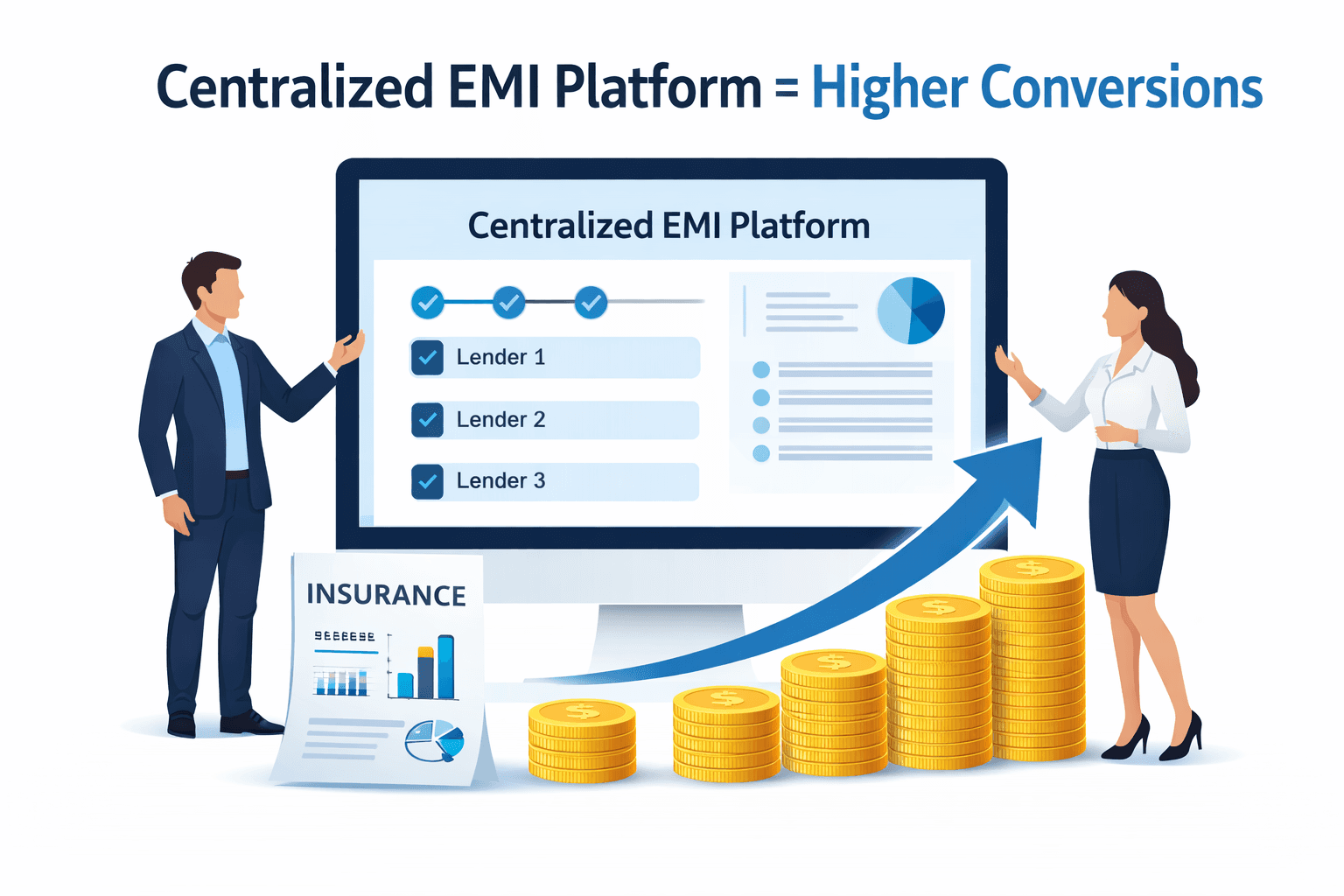
The Role of a Centralized EMI Platform
A centralized premium financing platform changes how EMI payments function within insurance sales journeys.
Instead of presenting multiple disconnected financing options, a single platform connects customers to multiple lenders through one unified application.
The customer fills one digital form.
Behind the scenes, eligibility is checked across multiple EMI providers simultaneously.
From the customer’s perspective, the process feels simple and immediate.
From a sales manager’s perspective, conversion probability increases significantly.
Increasingly, insurers are evaluating such infrastructure as part of selecting the best premium financing solution to support large-scale distribution performance.
One Form, Multiple EMI Options: Why It Matters
The difference between multiple applications and a single centralized platform may appear minor operationally, but its impact on conversion is substantial.
When customers complete only one application:
Decision fatigue reduces
Approval chances improve through multi-lender matching
Sales momentum remains intact
Payment completion happens faster
Agents no longer need to manage lender selection manually.
Instead of searching for approval pathways, they can focus on advising customers and closing policies.
This directly contributes to higher issuance rates.
Reducing Drop-Off at the Checkout Stage
Industry observations consistently show that the highest insurance drop-offs occur between proposal approval and payment completion.
A centralized EMI platform addresses this critical gap.
By offering all EMI payment options through one interface powered by a unified premium financing platform, customers receive immediate clarity on available repayment plans.
Approval uncertainty disappears.
Customers move from evaluation to confirmation within the same interaction.
For sales managers tracking daily closures, fewer pending cases translate into stronger conversion ratios and improved productivity across teams.
Supporting Agents Without Increasing Workload
Sales performance improvements often require either more leads or more effort from agents.
Centralized EMI infrastructure improves outcomes without either.
Agents avoid repetitive documentation processes. Training complexity reduces because teams learn one system instead of multiple lender workflows.
Operational efficiency improves naturally.
When agents experience smoother closures, confidence increases and selling behaviour improves across branches.
Higher Approvals Through Multi-Lender Access
One of the major limitations of traditional EMI enablement is dependency on a single financing partner.
If eligibility criteria are not met, the sale is lost.
A centralized platform connected to multiple lenders increases cumulative approval probability.
Customers who may not qualify under one credit policy may still receive approval through another.
For sales managers, this translates into fewer lost opportunities and more successful conversions from existing demand.
Higher approval coverage directly supports target achievement.
Faster Closures Mean Faster Target Achievement
Insurance targets are often missed not due to lack of pipeline but due to delayed closures.
When EMI approvals happen quickly through a unified system, payment completion accelerates.
Policies are issued earlier in the sales cycle rather than accumulating toward month-end pressure.
Managers gain better forecasting visibility, while teams experience reduced closing stress.
Speed becomes a competitive advantage.
Why Centralized EMI Platforms Are Becoming Essential
Across the insurance ecosystem, modern companies offering premium on EMI and emerging premium financing startups are moving toward centralized approval infrastructure.
The objective is clear.
Remove payment friction without increasing operational complexity.
A unified EMI-enabled premium financing platform aligns customer affordability, agent efficiency, and managerial performance metrics.
Instead of treating financing as an optional add-on, insurers increasingly integrate EMI infrastructure directly into distribution workflows.
Conversion Improvement Starts with Payment Simplicity
Insurance selling ultimately depends on trust and timing.
When customers decide to purchase coverage, the payment journey must reinforce confidence rather than introduce complexity.
A single EMI platform ensures that affordability solutions remain simple, fast, and accessible.
For insurance sales managers, this translates into measurable outcomes:
Higher conversion rates
Reduced drop-offs
Faster closures
Improved team productivity
In a competitive market, simplifying payment may be one of the most effective ways to help teams achieve targets consistently.
Because often, the difference between intent and issuance is not demand.
It is how easy it is for customers to pay.
Insurers evaluating premium financing platforms can refer to our detailed platform guide.
Related reads

Single NBFC vs Multi-Lender EMI for Insurance: What Sales Heads Should Know
Explore the difference between single NBFC and multi-lender EMI models for insurance premium financing in India and how lender architecture impacts approval rates and policy conversion.

How Insurance Sales Managers Can Help Their Teams Achieve Targets Faster with Premium Financing
Learn how premium financing platforms help insurance sales managers improve team productivity, close policies faster, and achieve sales targets through EMI-based premium financing solutions.

Understanding Premium Financing Platforms in India: A 2026 Guide for Insurance Companies
A comprehensive guide for insurers evaluating premium financing platforms in India, covering financing models, approval structures, and how centralized platforms improve insurance conversions.

Multiple Lenders, One Form: How Insurance Agents Can Give Customers More EMI Options With a Single Eligibility Check
Learn how access to multiple lenders, banks and NBFCs through one simple eligibility check can help insurance agents simplify EMI conversations and give customers more payment options.