Single NBFC vs Multi-Lender EMI for Insurance: What Sales Heads Should Know

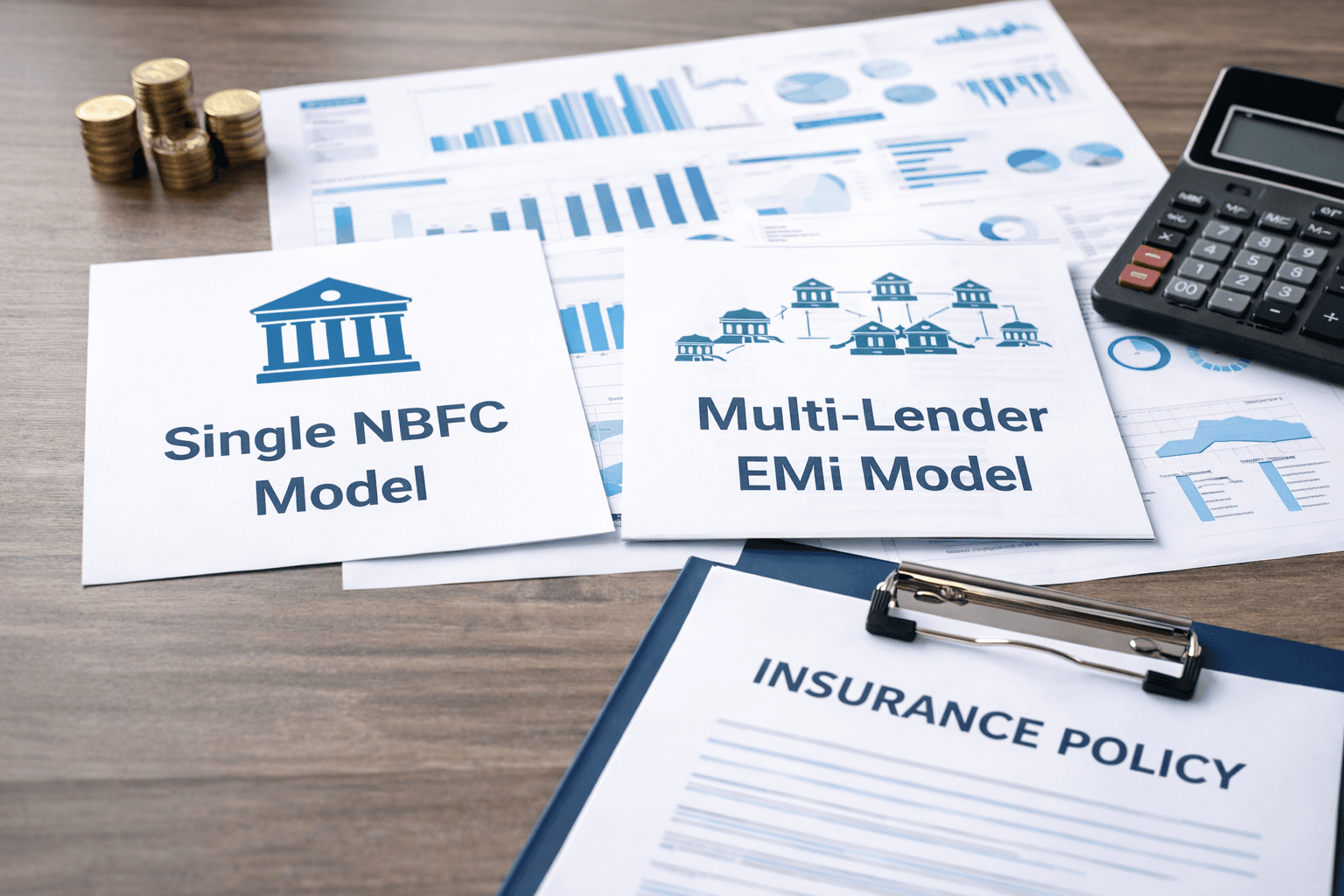
Insurance premium financing in India is no longer an optional feature for high-value policies.
As premium sizes increase, EMI for insurance premium payments has become a structural lever to improve conversions and accelerate revenue growth.
However, one critical strategic decision often gets overlooked:
Should insurers partner with a single NBFC for EMI, or adopt a multi-lender EMI platform?
At first glance, both models appear similar. Both enable customers to pay premiums in installments. Both promise improved affordability.
But the impact on approval rates, policy conversion, and revenue scale can differ significantly.
This article breaks down what sales heads and distribution leaders must evaluate before choosing their insurance premium financing model.
Why EMI Structure Matters More Than You Think
When insurers introduce EMI, expectations are straightforward:
Higher approval rates
Reduced payment friction
Improved policy conversion
Increased average ticket size
But EMI effectiveness is directly linked to lender architecture.
If approvals are inconsistent or restrictive, the financing model itself becomes a bottleneck.
The question is not whether to offer EMI.
The question is how to structure it for scale.
The Single NBFC EMI Model
Many insurers begin their premium financing journey with a single NBFC partnership.
This approach is simple to implement and operationally straightforward.
How It Works
Insurer partners with one lending institution
Customer applies for EMI through that lender
Approval is based on that lender’s credit policy
If approved, policy is issued
While this model provides EMI capability, it introduces structural limitations.
Limitations of a Single NBFC Model
1. Approval Rate Dependency
Every lender has a defined risk appetite.
If a customer falls outside that credit policy, the EMI application is declined.
With only one lender in the ecosystem, a decline often means:
Lost policy.
For sales teams, this creates unpredictability in closure rates.
2. Geographic and Customer Segment Constraints
Different lenders perform differently across:
Income segments
Employment types
Tier 2 and Tier 3 cities
Self-employed profiles
A single NBFC cannot optimize across all customer cohorts.
This limits scale.
3. Concentration Risk
Dependency on one lending partner creates operational and commercial risk:
Credit policy changes
Approval tightening
Regulatory adjustments
Commercial renegotiations
Sales momentum should not depend on one lender’s internal decision-making.
4. Agent Confidence Erosion
If agents frequently experience EMI rejections, confidence drops.
When EMI becomes unreliable, agents revert to lump sum positioning.
This weakens the core objective of offering insurance premium financing.
The Multi-Lender EMI Platform Model
A multi-lender EMI platform integrates multiple NBFCs within a single financing architecture.
Instead of routing applications to one lender, the system matches customers to the most suitable lender based on eligibility criteria.
From a customer and agent perspective, the experience remains seamless.
From a conversion standpoint, the impact can be significant.
Advantages of Multi-Lender Insurance Premium Financing
1. Higher Cumulative Approval Rates
Different lenders have different underwriting models.
A customer declined by one lender may qualify under another.
This dramatically increases cumulative approval probability.
For insurers, more approvals directly translate into:
More issued policies.
2. Broader Customer Eligibility
Multi-lender structures support:
Salaried professionals
Self-employed individuals
Business owners
Customers from Tier 2 and Tier 3 markets
This enables insurers to scale EMI penetration across diverse customer segments.
3. Reduced Drop-Offs at Checkout
When EMI is available but approvals are inconsistent, drop-offs increase.
Multi-lender systems reduce rejection-related drop-offs and strengthen checkout stability.
For digital journeys, this is critical.
4. Improved Agent Productivity
Reliable EMI approvals empower agents to confidently position higher-value policies.
When financing is dependable:
Objection handling becomes easier
High-sum insured plans become more sellable
Sales cycles shorten
EMI shifts from being a fallback option to a proactive sales tool.
5. Risk Diversification
Multi-lender architecture reduces concentration risk.
It protects insurers from operational disruptions linked to a single financing partner.
For leadership teams, this improves long-term sustainability.
Revenue Impact: The Sales Head Perspective
From a sales leadership standpoint, the key question is:
Which model improves policy conversion rate and ticket size at scale?
Single NBFC model:
Simpler to start
Lower operational complexity
But limited approval flexibility
Multi-lender model:
Higher approval probability
Greater customer coverage
Stronger scalability
Better alignment with revenue targets
If EMI is positioned as a revenue lever rather than a payment feature, approval architecture becomes a strategic decision.
When Should Insurers Consider Moving to Multi-Lender?
Sales heads should evaluate transition when:
EMI rejection rates exceed internal benchmarks
High-value policy conversions remain inconsistent
Agents report affordability objections despite EMI availability
Geographic expansion requires broader credit appetite
Growth targets depend on improving checkout conversion
At scale, financing structure directly influences revenue outcomes.
Implementation Considerations
Before adopting a multi-lender EMI platform, insurers should assess:
Integration complexity
API capabilities
Approval turnaround time
Zero down payment options
Compliance and regulatory alignment
Customer data security
The right platform should deliver:
Digital, paperless processing
Seamless agent-assisted flow
Real-time eligibility checks
Transparent reporting
EMI must enhance the sales journey, not complicate it.
The Strategic Shift: From EMI Feature to Growth Engine
Insurance premium financing is evolving.
What began as a payment flexibility feature is now a structural conversion strategy.
The insurers that treat EMI as a strategic revenue architecture rather than a checkbox feature will see stronger outcomes in:
Policy conversion rates
Average premium value
Agent productivity
Competitive positioning
In high-value insurance categories, approval rate equals revenue.
And approval rate depends on architecture.
For sales heads looking to finish quarters stronger and scale distribution efficiently, the choice between single NBFC and multi-lender EMI is not operational.
It is strategic.
Insurers evaluating premium financing platforms can refer to our detailed platform guide.
Related reads

Your Premium Financing Partner Is a Data Processor Too. Are You Governing Them Like One?
The new DPDP Rules put insurer-TPA contracts under scrutiny, but premium financing partners handle the same policyholder data. Here's what CXOs should be asking before they let customers pay premium on EMI.

Understanding Premium Financing Platforms in India: A 2026 Guide for Insurance Companies
A comprehensive guide for insurers evaluating premium financing platforms in India, covering financing models, approval structures, and how centralized platforms improve insurance conversions.

How Insurance Sales Managers Can Help Their Teams Achieve Targets Faster with Premium Financing
Learn how premium financing platforms help insurance sales managers improve team productivity, close policies faster, and achieve sales targets through EMI-based premium financing solutions.

Insurance Premium Financing in India: How EMI Increases Policy Conversions for Insurers
Learn how insurance premium financing and zero down payment EMI help insurers increase policy conversions, improve average ticket size, and accelerate revenue growth without increasing acquisition costs.