How Insurance Agents Can offer Loan for Health Insurance Premiums and Close More Sales


For an insurance agent, one of the most frustrating situations is when a customer clearly understands the value of health insurance but still does not buy the policy.
The reason is often simple: affordability.
A customer may want ₹5 lakh, ₹10 lakh or ₹20 lakh of health cover. They may understand why medical inflation makes insurance important. They may even agree that waiting another year is risky.
But when the conversation reaches the premium amount, the customer says:
“I’ll buy it next month.”
Or:
“Can you give me some time to arrange the money?”
This is where a loan to pay health insurance premium can become an additional sales-enablement tool for insurance agents.
Instead of allowing the premium amount to become the reason for losing the sale, agents can explore whether the customer is eligible to finance the premium and repay the amount over a defined tenure.
The result can be a more affordable payment experience for the customer and a potentially higher conversion opportunity for the agent.
What Is a Loan to Pay Health Insurance Premium?
A loan to pay health insurance premium is a financing arrangement where an eligible customer borrows money to pay the insurance premium and subsequently repays the financing amount through agreed instalments.
Instead of paying the entire premium upfront from available savings, the customer may be able to spread the repayment over a suitable tenure, subject to the lender’s terms, eligibility criteria, interest rate and other applicable charges.
For an insurance agent, the important point is this:
Premium financing is not about replacing insurance. It is about making the premium easier to manage for eligible customers.
This can be particularly relevant when the customer wants adequate health coverage but is hesitant about the immediate financial outflow.
Why Premium Affordability Becomes a Sales Barrier
Insurance is an important financial product, but it is also a product where the customer is paying today for protection against an uncertain future event.
That makes the purchase particularly sensitive to affordability.
Consider two customers:
Customer A can comfortably pay a ₹25,000 annual premium upfront.
Customer B wants exactly the same coverage but has competing monthly expenses and does not want to make a ₹25,000 one-time payment.
The product need is the same.
The difference is cash-flow availability.
Without an alternative payment or financing option, Customer B may postpone the purchase.
For an agent, postponement can mean:
A delayed policy sale
A lost opportunity
A customer remaining underinsured
Additional follow-ups
Increased chances of the customer abandoning the purchase
Premium financing can provide another route to address this objection.
How Can an Agent Use a Loan for Health Insurance Premium?
The conversation should ideally begin with the customer’s insurance requirement—not the loan.
An agent should first establish:
What coverage does the customer need?
What is the premium?
Why is the customer considering the policy?
Is the customer comfortable with the upfront premium?
Is affordability the only reason for delaying the purchase?
If affordability is the issue, the agent can explain that an eligible customer may have the option of financing the premium.
A typical journey may look like this:
Policy selection → Premium calculation → Financing eligibility check → Lender options → Approval → Documentation/mandate → Premium payment → Repayment
The exact journey depends on the financing platform and participating lenders.
Multiple Banks and NBFCs Can Create More Financing Possibilities
One important consideration for insurance distribution businesses is the lender ecosystem.
A financing journey that is connected to multiple banks and NBFCs can potentially provide more options than a journey dependent on a single lender.
Banks and NBFCs may have different:
Credit policies
Eligibility criteria
Risk parameters
Customer segments
Loan amounts
Tenures
Pricing structures
Therefore, a customer who does not fit one lender’s criteria may potentially fit another lender’s criteria, subject to the respective lender’s underwriting.
This is where a single-form, multi-lender journey can be valuable.
Instead of an agent asking the customer to repeatedly submit information to different lenders, a platform can enable the customer to submit a single application and potentially receive approval limits or offers from multiple participating banks and NBFCs, subject to eligibility and lender policies.
For the agent, this can reduce friction in the sales process.
What Is an Eligibility Check?
An eligibility check is essentially an assessment of whether a customer may qualify for financing based on the lender’s criteria.
Depending on the lender and product, this may involve factors such as:
Age
Income
Employment or business profile
Credit history
Existing financial obligations
Loan amount
Repayment capacity
Required documentation
Other lender-specific parameters
An eligibility check does not necessarily mean guaranteed loan approval.
Final approval remains subject to the lender’s underwriting, verification and applicable terms.
For agents, this distinction is important. Financing should always be presented transparently.
Bank vs NBFC: What Should Insurance Agents Know?
Customers may hear the terms bank and NBFC during the financing process and may ask what the difference is.
A bank is a financial institution that provides banking services and may offer loans and other financial products.
An NBFC, or Non-Banking Financial Company, is a financial company that provides certain financial services, including lending, but operates under a different regulatory framework from banks.
For an insurance agent, the important takeaway is not to position one category as universally better than the other.
Instead, agents should focus on:
Whether the customer is eligible
Loan amount available
Interest rate and applicable charges
Repayment tenure
Terms and conditions
Processing requirements
Customer suitability
When multiple lenders—including banks and NBFCs—are available, customers may have more financing possibilities.
What Is Down Payment in Premium Financing?
Depending on the financing product, a lender may require the customer to contribute a down payment or upfront amount.
For example, if the premium is ₹30,000 and the financing arrangement covers ₹25,000, the customer may need to contribute the remaining ₹5,000 upfront.
The exact structure varies by lender and product.
Agents should therefore avoid promising that the entire premium will always be financed.
Instead, the conversation should be:
“Let’s check your eligibility and see what financing options are available.”
That keeps the sales process transparent and customer-focused.
What Is a KFS?
Customers taking digital credit may encounter the term KFS, or Key Facts Statement.
A KFS is designed to provide important information about a loan in a clear format so that the borrower can understand the key terms before proceeding.
Depending on the applicable lending framework and product, the KFS can include information such as:
Loan amount
Annualised interest rate or applicable rate information
Repayment schedule
Tenure
Charges
Other key loan terms
For an insurance agent, the KFS is important because it helps separate the insurance transaction from the financing transaction.
The agent should encourage the customer to read and understand the applicable loan terms before accepting the financing.
What Is an E-Mandate?
An e-mandate is an electronic authorisation that can allow a lender or authorised entity to collect scheduled repayments from the customer’s designated bank account, subject to the applicable mandate terms.
For a customer using financing, this can make recurring repayments more convenient.
Instead of manually remembering each repayment date, the authorised payment mechanism can facilitate scheduled collections.
Agents should make sure customers understand:
What amount will be collected
When it will be collected
How long the mandate remains active
What happens if the account does not have sufficient funds
Any applicable charges or consequences
The exact mandate process depends on the lender and payment mechanism.
Understanding Repayment Tenure
Repayment tenure refers to the period over which the customer repays the financed amount.
For example, a lender may offer different repayment tenures depending on the product and customer eligibility.
A shorter tenure may mean a higher periodic repayment but potentially a shorter repayment period.
A longer tenure may reduce the periodic repayment but can affect the overall cost of borrowing.
Therefore, lower EMI does not automatically mean lower total cost.
Agents should encourage customers to evaluate the complete financing terms, not just the monthly repayment amount.
How Can Premium Financing Impact Policy Sales?
This is where the conversation becomes particularly relevant for insurance distribution leaders.
Suppose an agent is speaking to 100 interested customers.
If a portion of those customers are dropping out primarily because they cannot comfortably pay the premium upfront, introducing a financing option may give some of them another way to proceed.
That can potentially influence:
1. Conversion rates
A customer who was ready to buy but unable or unwilling to pay upfront may have another option.
2. Average policy value
Financing can potentially make higher-premium policies more manageable for eligible customers.
3. Cross-selling opportunities
Agents may be able to have broader conversations around adequate coverage instead of automatically selecting the cheapest policy because of upfront affordability.
4. Sales productivity
Agents spend significant time following up with customers who say they will “buy later.”
If financing resolves the affordability objection for an eligible customer, the sales cycle may become more efficient.
5. Customer experience
A customer gets another potential solution to a genuine cash-flow concern rather than simply being pushed to buy immediately.
How Agency Heads Can Enable Agents
Premium financing should not simply be treated as a payment link.
Agency/channel heads can make it part of the sales toolkit.
Agents can be trained to identify affordability objections such as:
“The premium is too high.”
“I need some time.”
“I can’t pay the whole amount right now.”
“I’ll buy it after my salary comes in.”
“Can I pay in instalments?”
The response should not immediately be:
“We have a loan.”
Instead:
“If affordability is the only concern, we can check whether you are eligible for a premium financing option.”
That is a fundamentally different sales conversation.
The Bigger Opportunity: From Premium Collection to Premium Financing
Insurance distribution is ultimately about getting more customers adequately insured.
But every sales funnel has friction.
For some customers, that friction is product understanding.
For others, it is trust.
For others, it is documentation.
And for a significant segment, it can simply be the upfront premium.
A loan for health insurance premium does not eliminate that financial commitment. It changes how an eligible customer may manage it.
For insurance agents, this creates another tool to address affordability objections.
For agency heads, it creates an opportunity to build financing into the broader sales strategy.
And for customers, it can potentially make the immediate cost of obtaining health protection more manageable.
Frequently Asked Questions
Can I take a loan to pay my health insurance premium?
Eligible customers may be able to finance their health insurance premium through participating lending partners, subject to lender eligibility, underwriting and applicable terms.
Can I pay my health insurance premium on EMI?
Depending on the financing option available, an eligible customer may be able to finance the premium and repay the financed amount through instalments over an agreed tenure.
Is the entire health insurance premium financed?
Not necessarily. The amount financed and any required upfront contribution or down payment depend on the lender and the specific financing product.
Can multiple banks and NBFCs provide financing options?
A multi-lender platform may connect eligible customers with multiple participating banks and NBFCs. Approval is subject to each lender’s eligibility and underwriting criteria.
Does an eligibility check guarantee loan approval?
No. An eligibility check is an indication of potential eligibility. Final approval is subject to the lender’s verification and underwriting process.
What is KFS in a loan?
KFS stands for Key Facts Statement. It provides important information about the loan and its key terms, helping the customer understand the financing before proceeding.
What is an e-mandate?
An e-mandate is an electronic authorisation used for scheduled payment collection from a customer’s bank account, subject to the applicable terms and process.
Does a longer repayment tenure mean the loan is cheaper?
Not necessarily. A longer tenure may reduce the periodic repayment but may increase the total cost of borrowing. Customers should evaluate the complete loan terms.
Can premium financing help insurance agents increase sales?
It can potentially help agents address affordability-related objections and give eligible customers another way to manage the premium. The impact on sales will depend on customer profile, product, pricing, eligibility and the agent’s sales process.
Conclusion
For insurance agents, affordability should not automatically become a lost-sales reason.
A customer may understand the importance of health insurance and still hesitate because of the upfront premium.
A financing option can give that customer another route.
With access to multiple banks and NBFCs, a single-form journey, eligibility checks and potentially available approval limits, premium financing can become a useful addition to an agent’s sales toolkit.
The objective is simple:
Help more eligible customers overcome premium affordability barriers—and make it easier for agents to convert genuine insurance demand into policy sales.
Related reads
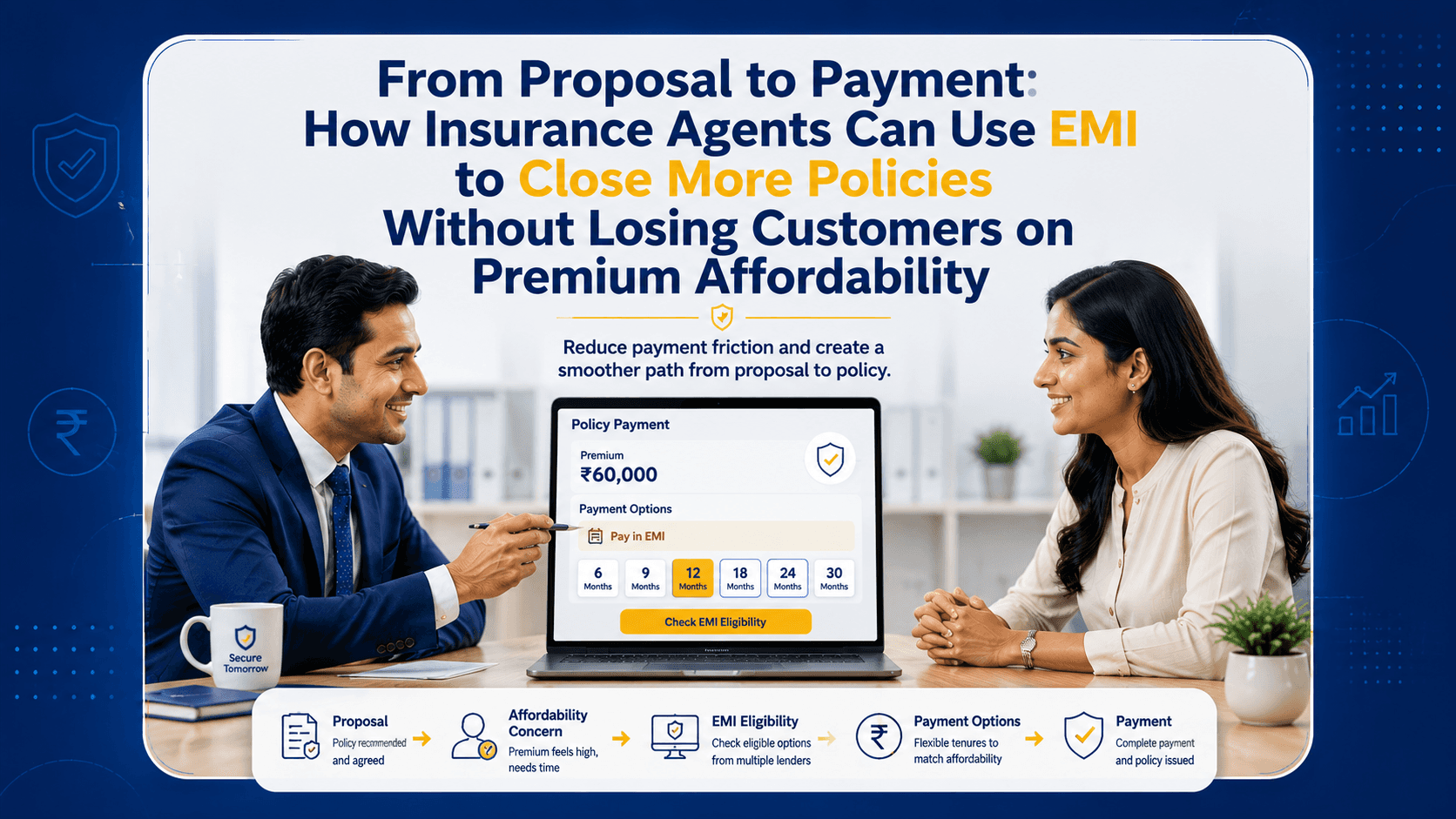
From Proposal to Payment: How Insurance Agents Can Use EMI to Close More Policies Without Losing Customers on Premium Affordability
Learn how insurance agents can use EMI as a payment option to address premium affordability concerns, reduce payment friction and create a smoother path from proposal to policy.

Multiple Lenders, One Form: How Insurance Agents Can Give Customers More EMI Options With a Single Eligibility Check
Learn how access to multiple lenders, banks and NBFCs through one simple eligibility check can help insurance agents simplify EMI conversations and give customers more payment options.

Why EMI Eligibility Checks Are Critical for Insurance Agents to Increase Policy Conversions
Why EMI Eligibility Checks Are Critical for Insurance Agents to Increase Policy Conversions

Get Loan to Pay Insurance Premium on EMI: A Guide for Agency Heads
How agency heads can help agents solve the affordability objection by understanding how customers can get a loan to pay insurance premium on EMI, and what to evaluate in a financing partner.