Multiple Lenders, One Form: How Insurance Agents Can Give Customers More EMI Options With a Single Eligibility Check


An insurance agent has a customer who is ready to buy.
The customer has explained their requirements. The agent has recommended a suitable policy. The coverage makes sense, the benefits are clear, and the customer is interested.
Then the premium comes up.
The customer says:
“I like the policy, but the premium is higher than I expected. Can I pay it in EMI?”
This is an important moment in the sales journey.
The customer has not rejected the policy. The concern is about how to manage the premium payment.
The agent now has to find out what EMI options may be available.
If the agent has access to only one financing provider, the process can become restrictive. The customer may not be eligible with that lender, the available tenure may not suit them, or the financing option may not fit their requirements.
The agent may then have to search for another lender, collect information again and start another process.
Now consider a different experience.
The agent fills in one form, checks the customer’s EMI eligibility and gets access to available options across multiple lenders, banks and NBFCs.
The customer can then understand which options may be available and make an informed decision.
This is the value of an all-in-one EMI platform.
It does not guarantee approval. It does not guarantee a policy sale. But it can potentially make the journey from premium objection to payment option simpler for both the agent and the customer.
For insurance businesses, this matters because the payment experience is part of the overall sales experience.
Why One Customer May Need More Than One Financing Option
Insurance customers do not all have the same financial profile.
Two customers may be interested in the same policy and have similar premium amounts, but their eligibility for financing can be different.
One customer may qualify with a particular lender.
Another may not.
Even when both customers are eligible, they may have different preferences around repayment tenure or financing terms.
This is why having access to multiple lenders can be useful.
Instead of approaching financing as:
“Which lender will this customer qualify with?”
an agent can approach it as:
“Let me check what financing options may be available for this customer.”
That is a more useful conversation.
It also reduces the pressure on the agent to identify the right lender before they even know the customer’s eligibility.
Of course, final approval, pricing, tenure and other terms remain subject to the individual lender’s criteria and the customer’s eligibility.
The role of multiple lenders is to create more possibilities, not to promise approval.
The Problem With Checking Lenders One by One
Imagine an agent has just closed a customer on a health insurance policy with a ₹60,000 annual premium.
The customer wants the coverage but asks about EMI.
The agent starts looking for a financing option.
The first lender does not approve the customer.
The agent now needs to try another lender.
This may mean:
Entering customer information again
Explaining the process again
Waiting for another eligibility response
Asking the customer for additional information
Coordinating between the customer and lender
Following up again
For the customer, this can feel like unnecessary friction.
For the agent, it takes time away from selling and servicing other customers.
For an agency, these additional steps can become difficult to manage when hundreds or thousands of agents are handling customers every day.
The problem is not necessarily that financing is unavailable.
The problem can be how fragmented the process is.
What Multiple Lenders Can Mean for Insurance Agents
Access to multiple lenders can change the role EMI plays in the insurance sales process.
Instead of the agent having to become an expert on every individual financing provider, the process can be more centralised.
More financing options for eligible customers
Different lenders have different eligibility criteria.
A customer who does not qualify for one option may potentially have another available option.
This does not mean approval is guaranteed.
It simply means the agent can check a broader set of possibilities.
Less manual searching
Agents spend their time selling insurance, advising customers and building relationships.
They should not have to spend excessive time searching for financing options manually.
A centralised process can reduce some of this operational effort.
Easier customer conversations
Instead of telling a customer:
“I’ll check with one lender and get back to you.”
the agent may be able to say:
“I can check your EMI eligibility and see what options may be available.”
This creates a more straightforward conversation.
Better sales workflow
The agent can potentially move from:
Premium objection → search for financing → lender selection → application
to:
Premium objection → eligibility check → available options → customer decision
The process becomes easier to understand.
Less operational friction
A simpler EMI process can potentially reduce repeated data entry, manual coordination and unnecessary follow-ups.
For large agency networks, even small improvements in process simplicity can matter because they are repeated across many customer interactions.
Why a Single Eligibility Check Can Make a Difference
The phrase “one form” may sound like a small operational detail.
For an agent, it can make a significant difference to how easily EMI fits into a sales conversation.
Consider the difference.
Fragmented process
Customer asks about EMI.
↓
Agent identifies a lender.
↓
Customer information is collected.
↓
Eligibility is checked.
↓
Customer is not eligible.
↓
Agent searches for another lender.
↓
Information may need to be entered again.
↓
Another eligibility check.
↓
Customer waits.
Simplified process
Customer asks about EMI.
↓
Agent fills one form.
↓
Available lender options are checked.
↓
Customer reviews the applicable option.
↓
Customer proceeds based on eligibility and terms.
The second process does not guarantee faster approval or a successful sale.
But it can potentially reduce process friction.
And reducing friction is particularly important at the point where the customer is already interested in the insurance policy.
The Role of an All-in-One EMI Platform
An all-in-one EMI platform essentially brings the financing workflow into a more centralised experience.
For an insurance agent, this can mean one place to initiate the eligibility process instead of navigating multiple lender processes separately.
For an insurance business, it can potentially make EMI easier to integrate into the agency sales journey.
The objective is not to turn agents into financing experts.
The objective is to give them a simple way to introduce payment flexibility when it is relevant.
The customer still needs to understand the financing terms and make their own decision.
The agent’s role is to facilitate the process.
EMI on Health Insurance Premium: A Practical Example
Consider a family looking for health insurance.
The family wants a higher sum insured and coverage for multiple members.
The agent recommends a suitable policy based on the family’s requirements.
The annual premium is ₹60,000.
The customer says:
“The coverage looks good, but ₹60,000 is difficult for me to pay at one time.”
This is an affordability objection.
The agent could immediately start discussing a lower coverage option.
But there may be another approach.
The agent can say:
“If you are comfortable with the policy, we can check whether you are eligible for an EMI option for the premium. I can check the available options for you.”
This is where EMI on health insurance premium can become relevant.
The agent can initiate an eligibility check.
If the customer is eligible, they may have access to applicable financing options through available lenders.
The customer can then decide whether the EMI option works for them.
The important point is that the customer is not being encouraged to choose more coverage simply because EMI exists.
The insurance recommendation should still be based on the customer’s needs.
EMI simply gives the customer another way to consider the payment.
Health Insurance on EMI and the Customer Conversation
The phrase Health Insurance on EMI is increasingly relevant to the way customers think about affordability.
A customer may not necessarily ask:
“Do you have an EMI financing product?”
They may simply say:
“Can I pay my health insurance premium monthly?”
The agent needs to understand the underlying requirement.
The customer may be looking for payment flexibility rather than a different insurance product.
This creates an opportunity to explain:
EMI on health insurance can be an available payment option for eligible customers, depending on the financing arrangement and applicable terms.
The agent can then explain the process without making the conversation unnecessarily complicated.
EMI on Life Insurance Premium: Another Important Use Case
Life insurance can also involve significant premium commitments.
A customer may want substantial financial protection but hesitate when they see the premium amount.
For example, a customer agrees with the recommended coverage but says:
“I want the policy, but I need to think about how I will manage the premium.”
The agent can explore whether an EMI option is available.
EMI on life insurance premium can potentially provide another payment route for eligible customers.
Similarly, customers may search for terms such as EMI on life insurance or Life Insurance on EMI when looking for ways to manage premium payments.
Again, the objective should not be to make EMI the centre of the insurance recommendation.
The sequence should remain:
Understand protection need → Recommend suitable policy → Explain premium → Discuss payment options where relevant.
Multiple Banks and NBFCs Can Give Agents More Flexibility
When an insurance business works with multiple financing providers, the agent can potentially offer customers a broader set of options.
This can include multiple banks and NBFCs.
Why does this matter?
Because eligibility is not necessarily the same across lenders.
Different lenders can have different:
Eligibility criteria
Risk policies
Tenure options
Financing terms
Customer requirements
An agent does not need to predict which lender will approve the customer.
A better approach can be to use a centralised eligibility process to determine what options may be available.
This is especially useful when the customer has already expressed interest in the policy.
The agent can keep the conversation moving rather than spending significant time figuring out where to send the customer next.
What an All-in-One EMI Platform Can Change for Agents
The biggest benefit of a centralised EMI process may not be the financing itself.
It can be the simplicity of the workflow.
Without a centralised process
The agent may need to:
Find a lender
Understand the lender’s process
Collect customer information
Submit details
Wait for a response
Try another lender if needed
Follow up with the customer
With an all-in-one platform
The process can potentially become:
Customer asks about EMI
↓
Agent fills one form
↓
EMI eligibility is checked
↓
Available options are shown
↓
Customer reviews applicable terms
↓
Customer decides whether to proceed
This can make EMI premium payment easier to introduce into the normal insurance sales process.
It can also help agency leaders standardise how agents handle affordability-related objections.
When Should an Agent Introduce EMI?
One common mistake would be to introduce EMI too early in every customer conversation.
EMI should not replace needs analysis.
A more appropriate approach is to introduce it when the payment structure becomes relevant.
For example:
Customer says:
“I like the policy, but the premium is high.”
Agent:
“If the policy suits your requirements, I can check whether you are eligible for an EMI option.”
Customer says:
“Can I pay the premium in instalments?”
Agent:
“We can check whether an EMI option is available for you and see what financing options you may be eligible for.”
Customer says:
“I need some time to arrange the full amount.”
Agent:
“If affordability is the main concern, would you like me to check your EMI eligibility?”
These conversations are more natural because EMI is being introduced as a response to a genuine customer need.
How Agency Leaders Can Build This Into the Sales Process
For Agency Channel Heads and Sales Heads, simply giving agents access to an EMI platform is not enough.
The process needs to become part of the sales workflow.
1. Train agents on the right trigger
Agents should know when EMI is relevant.
Training should focus on identifying affordability signals rather than telling every customer about EMI.
2. Give agents a simple script
A short script can make adoption much easier.
For example:
“If the premium is the only concern, we can check whether you are eligible for an EMI option. Would you like me to check?”
Agents can then adapt the language to their own style.
3. Make the eligibility process easy to access
If agents need to log into multiple systems or remember multiple lender processes, adoption can become difficult.
An easy one-form process is more likely to fit naturally into the sales conversation.
4. Provide customer communication templates
Agency teams can create ready-to-use:
WhatsApp messages
Follow-up messages
EMI FAQs
Eligibility instructions
Customer explanations
This helps agents communicate consistently.
5. Integrate EMI into CRM workflows
For example:
Lead created → Need identified → Proposal → Premium discussion → EMI eligibility if relevant → Payment → Policy issued
CRM integration can help make the process measurable.
6. Identify high-value segments
Agency leaders can use their own sales data to identify where EMI may be particularly relevant.
Examples include:
Higher-premium health insurance
Family health insurance
Higher-value life insurance
Customers opting for broader coverage
Customers who frequently delay premium payment
This creates a targeted approach rather than a blanket EMI pitch.
What Insurance Leaders Should Measure
Insurance leaders should evaluate EMI based on business outcomes and customer experience, not simply the number of EMI applications.
EMI eligibility checks
How many agents are actually using the eligibility process?
This indicates adoption.
Eligible customers
How many customers are found eligible for available financing options?
This helps leadership understand the potential reach of the program.
EMI adoption
Among eligible customers, how many choose an EMI option?
This helps determine whether customers find the option useful.
Proposal-to-policy conversion
Does the availability of EMI correlate with changes in proposal conversion for relevant segments?
This should be measured using actual agency data rather than assumed.
Premium collection
Track premium collected through customers using the applicable EMI payment route.
Average premium
Does payment flexibility help customers proceed with policies that meet their actual coverage needs rather than automatically moving to lower-premium options?
High-value policy conversion
This can be particularly useful for health and life insurance segments with larger premiums.
Agent productivity
Track:
Proposals handled
Policies sold
Premium generated
EMI-assisted sales
Follow-ups per conversion
Customer response rate
Measure whether customers engage more effectively when agents provide a clear payment option alongside the policy recommendation.
What Should Insurance Businesses Look for in an EMI Partner?
Not every EMI solution will fit an insurance agency’s sales process.
Agency leaders should evaluate the experience from the agent’s perspective as well as the customer’s.
Multiple lenders
A platform should provide access to multiple financing providers where applicable.
This gives eligible customers more potential options.
Multiple banks and NBFCs
Access to multiple banks and NBFCs can broaden the available financing choices, subject to lender eligibility criteria.
One-form EMI eligibility check
The eligibility process should be simple.
An agent should not need to complete separate processes for every lender just to understand what options may be available.
Multiple EMI tenures
Different customers have different repayment preferences.
Depending on the applicable financing arrangement, options can include different EMI tenures.
The customer should always be shown the actual available terms rather than being promised a particular tenure.
Clear customer communication
The customer should understand:
Financing provider
Eligibility
EMI amount
Tenure
Applicable charges
Repayment obligations
Terms and conditions
Transparency should be a core part of the experience.
Simple agent experience
The agent should be able to initiate the process quickly and understand the result without needing specialist financing knowledge.
EMI Premium Payment Should Fit Into the Insurance Journey
The goal of EMI premium payment should not be to create another complicated process for agents.
It should fit naturally into the insurance journey.
A good process might look like:
1. Customer requirement
↓
2. Suitable insurance recommendation
↓
3. Premium discussion
↓
4. Customer asks about affordability
↓
5. EMI eligibility check
↓
6. Available financing options
↓
7. Customer decision
↓
8. Premium payment and policy completion
This is a much more natural role for EMI.
It is not a substitute for insurance advice.
It is a payment option that can potentially help customers who are interested in the policy but need greater flexibility around the premium.
How ShopSe Can Help Insurance Businesses Offer Multiple EMI Options
Insurance businesses looking to bring EMI into their agency sales process can consider an all-in-one EMI platform such as ShopSe.
ShopSe can help insurance businesses and agency channels access EMI options through multiple lenders, banks and NBFCs, while simplifying the eligibility-check process.
Instead of an agent having to approach different financing providers separately, the process can be initiated through a single workflow.
For an insurance agent, this can make it easier to respond when a customer says:
“I want this policy, but I am not comfortable paying the entire premium upfront.”
The agent can check the customer’s EMI eligibility and understand what applicable options may be available.
The customer can then review the financing terms and make an informed decision.
The value for the insurance business is therefore broader than simply adding another payment option.
It is about making payment flexibility easier to integrate into the agency sales process.
The Bigger Opportunity for Insurance Agencies
For an insurance agent, a premium objection can sometimes feel like the end of a sales conversation.
But a customer saying:
“The premium is too high for me right now”
does not necessarily mean:
“I don’t want this insurance.”
It may simply mean:
“I need a different way to manage the payment.”
This distinction matters.
Access to multiple lenders can potentially give the agent more options to explore.
Access to multiple banks and NBFCs can broaden the financing network.
An all-in-one EMI platform can simplify the workflow.
And a single eligibility check can potentially reduce the effort required to understand what options may be available for a customer.
For health insurance, this can be relevant when family coverage or higher protection results in a larger premium.
For life insurance, it can be relevant when customers want meaningful protection but are concerned about managing a larger premium commitment.
For agents, terms such as EMI on insurance, Insurance on EMI, EMI on policy premium, Policy on EMI, Health Insurance on EMI and Life Insurance on EMI are ultimately different ways of describing a broader customer requirement:
“Can I manage this insurance premium differently?”
The answer will depend on the customer’s eligibility, the available financing providers and the applicable terms.
But giving agents a simple way to check those options can potentially make the sales process more efficient.
The goal should not be to push every customer towards EMI.
The goal should be to make sure that a customer who wants the right insurance coverage does not encounter unnecessary process friction simply because the premium payment requires another option.
For agency leaders, the opportunity is to build that flexibility into the sales journey in a structured, measurable and customer-first way.
FAQs
Can insurance premiums be paid through EMI?
Eligible customers may be able to use financing options to manage insurance premium payments through EMI, depending on the insurance payment process, financing provider and applicable eligibility criteria.
What does EMI on insurance mean?
EMI on insurance generally refers to using an eligible financing arrangement to pay an insurance premium through scheduled instalments rather than making the entire financed payment upfront.
Can health insurance premiums be paid through EMI?
Depending on the available financing arrangement and customer eligibility, an EMI option may be available for certain health insurance premium payments.
Can life insurance premiums be paid through EMI?
An EMI option may be available for applicable life insurance premium payments, subject to the relevant financing arrangement, policy process and customer eligibility.
Why are multiple lenders useful for insurance premium EMI?
Different lenders can have different eligibility criteria and financing terms. Access to multiple lenders can potentially give eligible customers more options to consider.
What is an all-in-one EMI platform?
An all-in-one EMI platform brings the EMI eligibility and financing workflow into a centralised process, potentially allowing agents to check available options without approaching multiple lenders separately.
How can insurance agents check EMI eligibility?
The process depends on the platform and financing providers involved. A one-form EMI eligibility check can simplify the process by allowing an agent to initiate the eligibility check through a single workflow.
Related reads
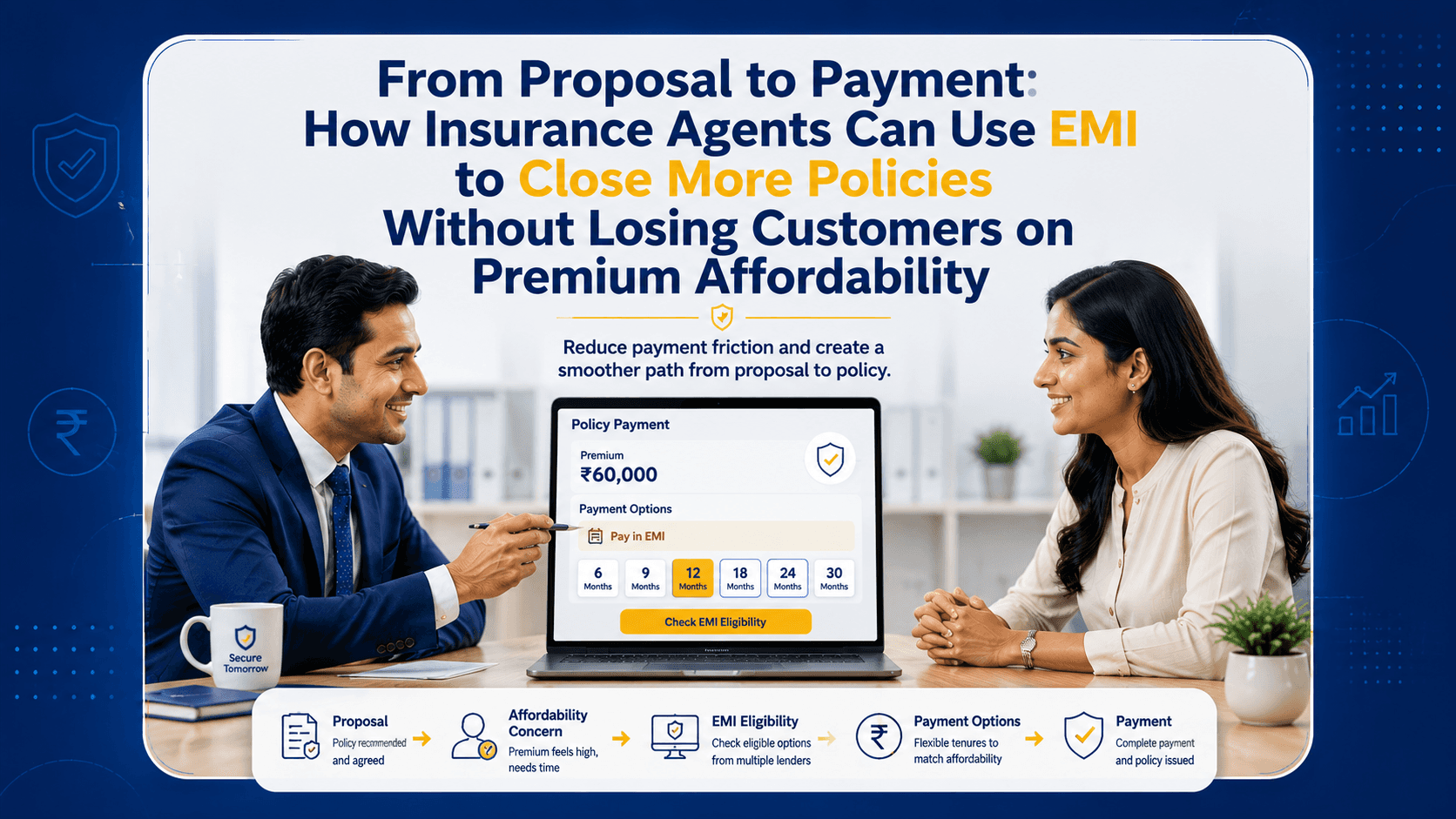
From Proposal to Payment: How Insurance Agents Can Use EMI to Close More Policies Without Losing Customers on Premium Affordability
Learn how insurance agents can use EMI as a payment option to address premium affordability concerns, reduce payment friction and create a smoother path from proposal to policy.

Single NBFC vs Multi-Lender EMI for Insurance: What Sales Heads Should Know
Explore the difference between single NBFC and multi-lender EMI models for insurance premium financing in India and how lender architecture impacts approval rates and policy conversion.

How Insurance Agents Can Sell More Policies by Offering EMI on Insurance Premium
Learn how EMI on insurance premiums can help insurance agents overcome affordability objections, improve policy conversions and potentially increase premium collection.

Why EMI Eligibility Checks Are Critical for Insurance Agents to Increase Policy Conversions
Why EMI Eligibility Checks Are Critical for Insurance Agents to Increase Policy Conversions