How Premium Financing Helps Maximize Policy Sales and How It Really Works


A strategic guide for insurance CXOs, distribution leaders, and product heads on solving the affordability problem at the point of sale
Executive Summary
Insurance underperforms its own market potential not because customers doubt its value, but because of a payment design flaw baked into the product itself: the annual lump-sum premium.
Across health, life, and general insurance, advisors routinely watch prospects who understand the need for coverage, trust the recommendation, and still walk away — because the premium, paid in one shot, doesn’t fit inside a monthly budget. This is the affordability gap, and it is largely invisible in most sales dashboards because it gets recorded as “lost lead” or “deferred decision,” not as what it actually is: a payment-structure failure.
Premium financing — the practice of converting an annual insurance premium into structured monthly instalments through a lending partner — closes this gap. It does not change the product, the underwriting, or the risk. It changes only the cash-flow shape of the purchase. And that single change has an outsized effect on conversion, average ticket size, and the depth of coverage a customer is willing to buy.
This report explains what premium financing is, why it is emerging as a strategic lever in insurance distribution — particularly in India — and how insurers, brokers, and agency networks can operationalize it without re-engineering their existing sales process.
1. What Is Premium Financing?
Premium financing is a lending arrangement in which a third-party financier — typically a bank or an NBFC (non-banking financial company) — pays the insurance premium to the insurer on the customer’s behalf, and the customer repays that amount to the lender in monthly instalments (EMIs), usually with a defined tenure and interest cost.
In its simplest form: a customer who needs to pay ₹48,000 for a health insurance policy today can instead pay a small down payment and roughly ₹4,200 a month for a year, through a lender integrated into the sales journey. The insurer receives full payment immediately and issues the policy without delay. The customer receives full coverage immediately, without draining a lump sum from their bank account. The financing relationship sits entirely between the customer and the lender — it is transparent to the insurer’s own economics.
It’s worth being precise about terminology here, because the term “premium financing” is used in two fairly different contexts, and conflating them is one of the reasons the topic is poorly understood.
Legacy/HNW premium finance — the version most global content on this topic describes — refers to large, collateralized loan structures used by ultra-high-net-worth individuals and corporations to fund life insurance or commercial property-and-casualty premiums, often for estate planning or tax efficiency, with policies pledged as collateral and loan sizes running into the crores or millions.
Retail premium financing — the version that matters for mass-market insurance distribution in India — is a much simpler, EMI-based product aimed at ordinary retail customers buying health, life, or general insurance, with ticket sizes typically between ₹5,000 and ₹1,00,000, no collateral requirement, and an approval process that takes minutes rather than weeks.
Legacy / HNW Premium Finance | Retail Premium Financing (India model) | |
|---|---|---|
Typical customer | High-net-worth individuals, corporations | Salaried and self-employed retail customers |
Ticket size | Crores/millions, multi-year policies | ₹5,000 – ₹1,00,000, mostly annual premiums |
Collateral | Policy cash value, other pledged assets | Typically unsecured |
Approval time | Weeks, with underwriting and legal documentation | Minutes to hours, digital and mobile-number-based |
Primary purpose | Wealth preservation, estate liquidity, tax planning | Affordability at the point of purchase |
Distribution channel | Private banks, wealth managers | Insurance agents, bancassurance, digital platforms |
This report focuses on the second category, because it is the one with the most immediate and measurable impact on policy sales volume, premium size, and distribution economics for mainstream insurers.
This also answers a related, commonly asked question: premium finance and premium financing mean the same thing — the terms are used interchangeably in the industry, with “financing” being the more common usage in retail and digital contexts, and “finance” appearing more often in the traditional HNW and commercial insurance literature.
A note on premium structures
Because premium financing intersects with how policies are priced, it’s useful to be clear on how premiums themselves are structured. Insurers generally price policies as a single premium (one lump-sum payment for the full policy term), a regular or level premium (equal payments recurring for the life of the policy), or a limited premium payment term (LPPT), where the customer pays premiums for a defined number of years — a 20-year premium term, for instance, being a common LPPT structure on long-tenure life policies — even though the coverage itself may extend well beyond that payment window. Premium financing is most commonly applied to the first year’s payment of a regular or single premium product, since that is where the affordability shock is largest relative to a customer’s monthly cash flow.
2. Why Customers Buy Less Insurance Than They Need
Insurance penetration in India remains low relative to the population’s actual protection needs, and the reason is rarely a lack of awareness. A large share of retail customers understand they are underinsured — they simply postpone or downsize the purchase because of how the payment is structured.
A few dynamics compound this:
Annual premium shock. A ₹40,000–₹80,000 lump sum for a family floater or a term life policy competes directly with rent, school fees, and existing loan EMIs — obligations that are already claiming a large share of monthly income for most Indian households.
Anchoring on the wrong number. Customers evaluate affordability by looking at the annual premium figure, not the monthly value of the protection it provides. A ₹60,000 annual premium feels large; a ₹5,000 monthly outlay for the same coverage feels manageable — even though the two are financially near-identical once financing cost is included.
Competing monthly commitments. Indian households already allocate a meaningful share of monthly income to existing instalment obligations — one industry estimate puts EMI-related spending at roughly a third of monthly salary for the average earning household. An annual insurance premium, framed as a lump sum, has to compete against that already-stretched monthly budget rather than sit alongside it.
Delayed decisions become lost decisions. “I’ll buy it next month when I have the money” is one of the most common outcomes in insurance sales — and one of the least tracked. Deferred purchases frequently never convert, because the moment of intent passes and is not recreated.
None of this reflects a lack of belief in insurance. It reflects a cash-flow mismatch between how insurance is priced (annually) and how most household budgets actually work (monthly).
3. The Biggest Bottleneck in Insurance Sales
Ask any experienced insurance advisor where deals are lost, and the answer is rarely “the customer didn’t understand the product.” It is almost always some version of: “they liked it, they just couldn’t pay for it right now.”
This is the paradox at the center of retail insurance distribution — the sales funnel does everything right up until the very last step, and then loses the customer at the exact moment the deal should close:
The lead is qualified.
The needs analysis is done correctly.
The right product is recommended.
The customer trusts the advisor and understands the benefit.
…and the sale stalls or dies at the payment screen.
This bottleneck is structural, not behavioral. It exists because affordability is treated as a payment-method question (“card or net banking?”) rather than as a sales-enablement question (“can we make this fit the customer’s monthly budget?”). Premium financing reframes affordability from an obstacle handled at checkout into a lever used earlier in the sales conversation — which is precisely what changes the outcome.
4. How Premium Financing Maximizes Policy Sales
When affordability stops being a constraint, customer behavior shifts in a predictable direction: toward more adequate coverage, not just toward a purchase.
Consider a simple, common scenario in health insurance distribution:
Without Premium Financing | With Premium Financing | |
|---|---|---|
Recommended plan | ₹5 lakh family floater | ₹15 lakh family floater |
Annual premium | ₹18,000 | ₹42,000 |
Customer’s likely decision | Downgrades to fit the ₹18,000 they can pay upfront | Pays a small down payment + ~₹3,500/month over 12 months |
Outcome | Underinsured family, lower premium, lower advisor commission | Adequately insured family, ~2.3x higher premium, higher advisor commission |
The same logic applies to life insurance, where financing a first-year premium often means the difference between a customer buying an adequate sum assured and settling for a policy sized to what they can pay in one instalment rather than what their family actually needs.
This directly addresses one of the more common practical questions insurance buyers and distributors ask: is premium financing worth it? The honest answer is: it depends on what’s being compared. Financing adds a cost — interest and, in some structures, processing fees — so a customer who could comfortably pay the full premium upfront has no financial reason to finance it. But for the much larger segment of customers who would otherwise downgrade coverage, delay the purchase, or walk away entirely, the calculation changes: the “cost” of financing is small relative to the cost of being meaningfully underinsured, or of losing the protection altogether while the customer waits to save up. For insurers and distributors, the answer is more straightforward — premium financing is worth deploying whenever it converts a sale that would otherwise not have happened, or upgrades one that would otherwise have been undersized.
5. How Premium Financing Changes the Sales Funnel
Most insurance sales funnels are built around four stages: lead capture, needs analysis, product recommendation, and payment. Affordability is typically only tested at the final stage — which means it’s discovered too late to influence anything upstream.
Inserting an affordability/financing-eligibility check earlier in the funnel changes what the funnel optimizes for:
Funnel Stage | Traditional Approach | With Premium Financing Built In |
|---|---|---|
Lead capture | Demographic and contact data only | Add EMI-eligibility check via mobile number |
Needs analysis | Recommend based on ideal coverage | Recommend based on ideal coverage, unconstrained by upfront cash |
Product recommendation | Advisor mentally pre-filters by what customer can pay in one shot | Advisor can recommend the right sum assured, not the affordable one |
Payment | Single go/no-go moment; large drop-off | Multiple viable payment paths; lower drop-off |
Post-sale | Persistency depends on the customer having budgeted for a large renewal outlay | Persistency supported by predictable monthly instalments |
The practical effect on distribution economics tends to show up in four places: conversion rate (fewer prospects abandon at the payment stage), average premium per policy (customers buy closer to their actual need rather than their upfront cash constraint), advisor productivity (fewer stalled deals, less re-pitching), and policy mix (a higher share of comprehensive, adequately-sized policies rather than minimum-viable ones).
6. How Premium Financing Actually Works
The end-to-end journey, whether for a health, life, or general insurance premium, generally follows five steps:
Step 1 — EMI eligibility check. The customer’s basic details (commonly just a mobile number) are used to run a quick eligibility check against one or more lending partners. This happens in seconds, before the customer commits to anything.
Step 2 — Lender approval. Based on the eligibility check, the customer sees which NBFCs or banks are willing to finance the premium, along with the tenure and EMI amount each offers. In a well-designed digital journey, this is a single form that fans out to multiple lenders rather than a separate application for each one.
Step 3 — Premium payment. Once the customer selects a lender and tenure, the lender pays the full premium amount to the insurer directly. The insurer’s cash flow is unaffected — it receives payment exactly as it would through any other payment mode.
Step 4 — Policy issuance. Because the insurer has been paid in full, the policy is issued immediately, with no dependency on the customer’s repayment schedule to the lender.
Step 5 — EMI repayment. The customer repays the lender over the agreed tenure — typically 3 to 12 months for retail premium financing — through auto-debit, UPI AutoPay, or a similar mandate.
It’s worth noting that this is structurally different from the instalment payment option that IRDAI directed general and health insurers to offer starting in 2019 (and accelerated in 2020). That mechanism lets a customer pay the insurer itself in periodic instalments — it is a payment-frequency feature, not a loan, and typically carries only a small frequency loading rather than market interest rates. Premium financing, by contrast, involves an actual third-party lender who pays the insurer in full upfront and lends the money to the customer — closer in structure to card-based EMI, but usually at a lower cost and with a purpose-built underwriting flow, since it isn’t routed through general-purpose consumer credit. Distributors are best served by knowing both options exist and steering the customer to whichever preserves the insurer’s cash position while giving the customer the lowest-cost path to the coverage they need.
Broadly, three types of arrangements exist for spreading a premium over time, and it is useful for CXOs to know all three, since customers frequently arrive having heard the term “EMI” without knowing which version applies to them:
Insurer-led instalment plans — the IRDAI-enabled option described above; not a loan, small loading, offered directly by select insurers on select products.
Card-based EMI — the customer’s existing credit card issuer converts the premium into EMIs; convenient, but usually carries the card issuer’s standard EMI interest rate (commonly in the 12–18% range) and depends on the customer already holding a card with sufficient limit.
NBFC/bank premium financing — a dedicated third-party lender finances the premium through a purpose-built digital journey; this is the model most relevant to the affordability strategy described in this report, since it doesn’t require the customer to already hold a credit card and can be underwritten specifically for insurance use cases.
7. The Modern Premium Financing Experience
The reason premium financing has moved from a niche commercial-insurance tool to a mainstream retail lever is entirely due to digital infrastructure. A decade ago, financing a premium meant paperwork, physical verification, and multi-day turnaround — friction that defeated the entire purpose of removing friction from the sale.
Modern digital platforms have compressed that into something that fits inside a single sales conversation:
Instant EMI eligibility checks, often needing nothing more than the customer’s mobile number to return a preliminary result.
Aggregated approvals across multiple NBFCs and banks, so a decline from one lender doesn’t end the conversation — the customer is routed to the next eligible lender automatically.
Minimal paperwork, with KYC handled digitally through DigiLocker, e-Aadhaar, or similar rails rather than physical documents.
Fast disbursal, meaning the insurer is paid and the policy is issued within the same session the customer was originally quoted a premium in.
For an advisor mid-conversation, this means affordability can be resolved in the time it takes to check a WhatsApp message — not escalated to a follow-up call three days later, by which point the customer’s intent has usually cooled.
8. How ShopSe Enables Premium Financing
Insurers and distribution partners looking to build affordability into their sales process don’t need to become lenders themselves, or integrate individually with a dozen NBFCs. This is the specific problem platforms like ShopSe are built to solve.
ShopSe operates as a premium financing layer that sits between an insurer’s (or broker’s) sales journey and a panel of lending partners — including NBFCs and banks — so that affordability can be resolved in real time, at the point of sale, without the insurer taking on any credit risk or operational burden.
In practice, this looks like:
A quick EMI eligibility check using just the customer’s mobile number — no lengthy application before the customer even knows whether financing is viable.
Approval across multiple NBFCs and banks through a single form — rather than the customer (or advisor) manually shopping the application to each lender separately, one submission is evaluated against the full panel.
A single platform for multiple financing options, so different customers — with different income profiles, credit histories, or ticket sizes — can each be matched to the lender most likely to approve them, without the insurer needing separate integrations for each.
A digital journey built for insurance-specific ticket sizes and use cases — health, life, and general insurance premiums, rather than a generic consumer-lending product retrofitted for insurance.
The result for the insurer’s distribution team is straightforward: the affordability conversation that used to end sales can now happen inside the sales journey itself, resolved in minutes, with the insurer still collecting the full premium value upfront and taking on none of the lending exposure.
9. Strategic Benefits for Insurance Companies
For an insurer or broker evaluating whether to build premium financing into their distribution strategy, the case rests on a small number of measurable outcomes:
Benefit | Why It Happens |
|---|---|
Fewer prospects abandon the purchase at the payment stage, since the objection (“I can’t pay this right now”) is resolved rather than left unanswered | |
Higher premium per policy | Customers select coverage based on need rather than upfront cash constraint, lifting average sum assured and premium size |
Better persistency | Predictable monthly outflows are easier for households to sustain than a single large annual renewal payment |
Improved advisor productivity | Fewer deals stall for re-pitching later; affordability is resolved in the same conversation as the recommendation |
Lower payment-stage drop-off | Financing offers a viable path for customers who were never going to pay the full premium in one transaction |
Revenue growth without product changes | The lever is entirely in the payment layer — no new product design, underwriting change, or pricing revision required |
Improved customer experience | Customers get the coverage that matches their actual risk, not a scaled-down version dictated by cash flow |
None of these benefits require the insurer to change its products, its underwriting philosophy, or its pricing. They require only a change in how the payment moment is structured — which is precisely why premium financing has a disproportionately favorable cost-to-impact ratio compared to most other distribution interventions.
10. The Future of Insurance Distribution
Insurance distribution in India has spent the last decade digitizing everything upstream of payment — lead capture, needs analysis, KYC, even underwriting in some segments. Payment has been the one part of the journey that stayed largely unchanged: quote the annual premium, collect it, issue the policy.
That is starting to shift, for a straightforward reason: insurers that treat affordability as a sales-enablement problem, not a back-office payment detail, are converting a segment of the market that other insurers are simply losing to deferred decisions and downgraded coverage.
Premium financing is unlikely to remain a differentiator for long — as EMI-based purchasing has become the default for consumer durables, electronics, and even school fees in India, customers will increasingly expect the same flexibility when buying insurance. The insurers who build this into their core sales process now, rather than treating it as an experimental add-on, are the ones best positioned to capture the segment of the market that has been quietly walking away for years — not because they didn’t want coverage, but because no one made it fit their monthly budget.
Key Takeaways
Affordability, not lack of intent, is the primary reason customers underbuy or defer insurance purchases.
Retail premium financing (EMI-based, NBFC/bank-led) is structurally different from both legacy HNW premium finance and IRDAI’s insurer-led instalment option — and distributors should know which one they’re actually offering.
Premium financing works by having a lender pay the insurer in full upfront, while the customer repays in instalments — the insurer’s cash position is unaffected.
Built early into the sales funnel rather than left to the payment screen, financing shifts customer behavior toward adequate, need-based coverage rather than downsized, budget-constrained coverage.
The strategic upside for insurers — higher conversion, larger average premium, better persistency — requires no change to products or underwriting, only to how the payment moment is designed.
Related reads

Premium Financing: The Missing Stage in India's Insurance Sales Funnel
Affordability, not intent, is why insurers lose sales. See how premium financing turns EMI eligibility into a formal funnel stage that lifts sum assured, tenure, and conversions.

Loan to Pay Insurance Premium on EMI: How Premium Financing Helps Insurers Sell More Policies
How loan to pay insurance premium on EMI is turning premium financing into a strategic growth lever for insurers, agents, and distribution leaders.
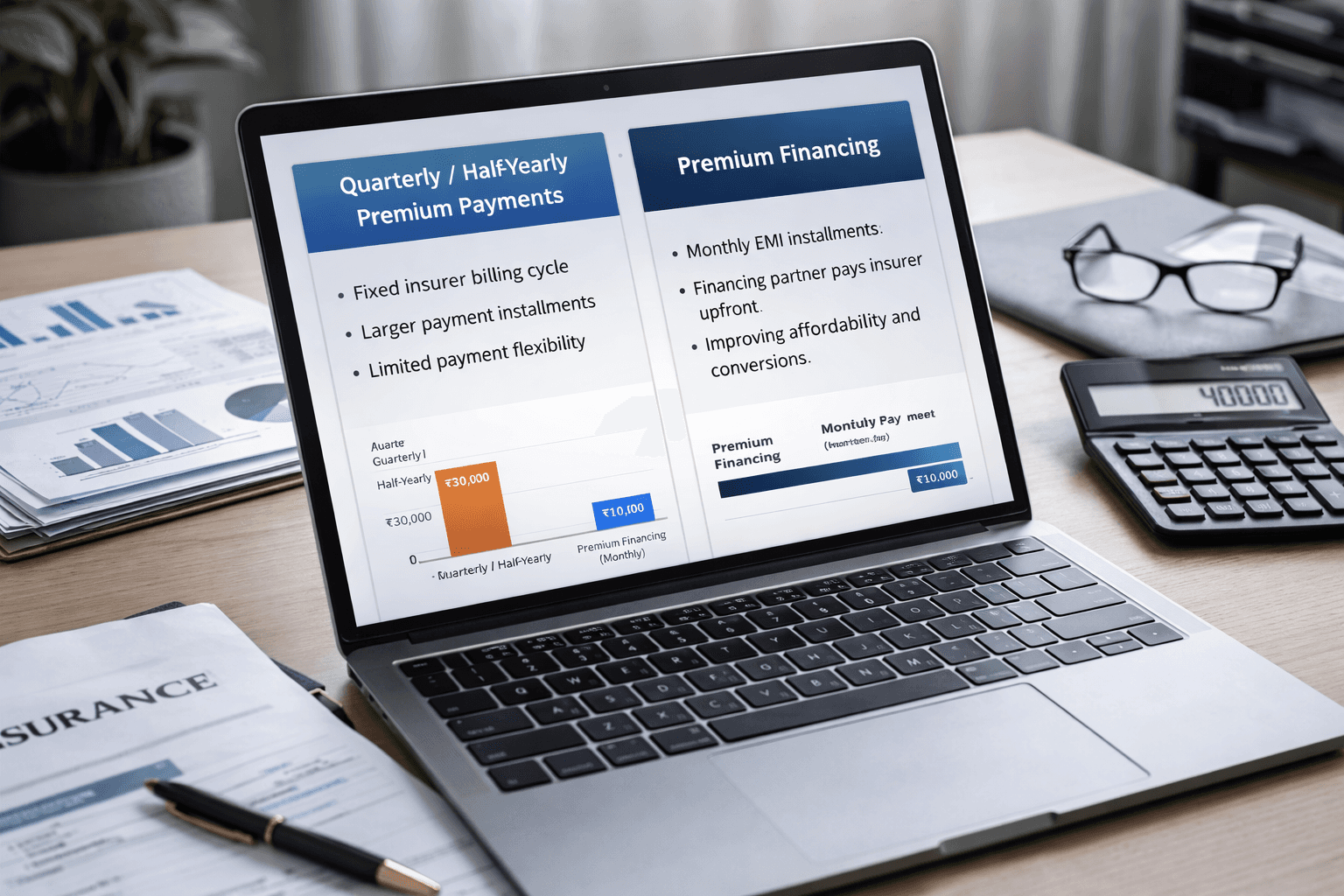
Quarterly and Half-Yearly Premium Payments vs Premium Financing: What Insurers Should Know
Explore the difference between quarterly insurance premium payments and premium financing, and how financing helps insurers improve policy affordability and conversions.

Why Premium Financing Should Start at Lead Capture
Checking premium financing eligibility at lead capture — not payment — helps insurers boost conversions, unlock multiple NBFCs and banks, and turn affordability into a sales advantage.