From Proposal to Payment: How Insurance Agents Can Use EMI to Close More Policies Without Losing Customers on Premium Affordability

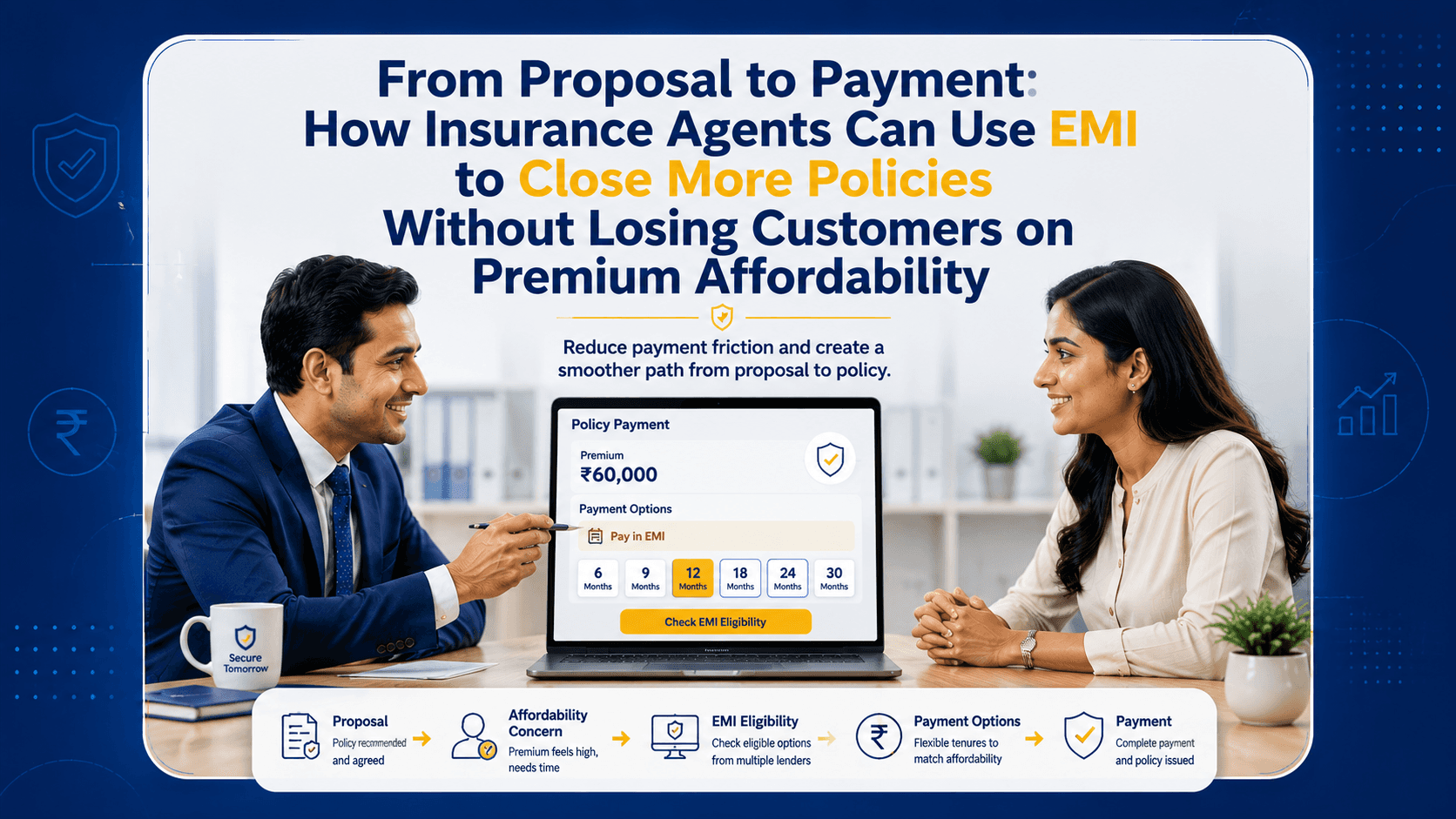
Learn how insurance agents can use EMI on insurance premium to address affordability concerns, reduce payment friction and create a smoother path from proposal to policy.
An insurance agent has done most of the work.
They have understood the customer’s requirements. They have discussed the customer’s priorities. They have recommended a suitable policy and explained the coverage.
The customer agrees.
The proposal is ready.
Then the premium amount comes up.
The customer says:
“The policy looks good, but I need some time to arrange the money.”
This is a critical moment in the insurance sales journey.
The customer has not necessarily rejected the policy. They may understand the need for the coverage and even agree that the recommended policy is suitable.
The barrier may simply be the payment.
For agents, this is where the conversation can either lose momentum or move towards a practical solution.
One option worth considering, where applicable and subject to customer eligibility, is EMI on insurance premium.
EMI should not be treated as a way to push a customer into buying a policy they do not need. It should be viewed as another payment option that can potentially help a customer who is interested in the policy but finds the upfront premium difficult to manage.
For insurance agencies, this creates an important question:
How can agents identify genuine affordability concerns and use payment flexibility to make the journey from proposal to payment smoother?
1. The Last 10% of the Sales Journey Can Decide the Outcome
Insurance sales involve several stages before the premium is actually paid.
A customer may move through:
Interest → Need discussion → Product consideration → Proposal → Purchase intent → Payment
Each stage is different.
A customer expressing interest is not the same as a customer ready to buy.
A customer accepting a proposal is not the same as a customer who has completed payment.
This distinction matters because agents often focus heavily on getting the customer to agree with the product.
But the final payment can still become a separate barrier.
For example:
Customer: “Yes, this is the coverage I need.”
Agent: “The annual premium is ₹60,000.”
Customer: “Okay. Let me arrange the money and get back to you.”
The customer has moved almost to the end of the journey, but the policy is still not completed.
The agent now faces another follow-up.
And the longer the customer takes to act, the greater the possibility that the purchase loses momentum.
This is why the proposal-to-payment stage deserves its own sales strategy.
2. Why Customers Say “I’ll Get Back to You”
When a customer says they need time to arrange the premium, an agent should avoid immediately assuming that the customer has rejected the policy.
There can be several reasons behind the response.
The premium is higher than expected
The customer may have expected a lower amount, even though they agree with the coverage.
Cash flow timing
The customer may have the ability to pay but may not have the full amount available at that particular time.
Competing expenses
A customer may be managing school fees, household expenses, investments, business expenses or other financial commitments.
The customer wants to compare options
They may want to compare another policy before committing.
Family decision-making
A spouse or another family member may need to be involved before the payment is made.
The customer wants payment flexibility
Sometimes the issue is not the total premium itself. The issue is paying the entire amount at once.
This is an important distinction for agents.
Instead of responding to every delay by reducing the premium or offering a different policy, the agent should first understand why the customer is hesitating.
A simple question can help:
“Is the concern with the policy itself, or is it mainly about managing the premium payment?”
If the customer says payment is the concern, EMI may be worth exploring.
3. When EMI Can Become a Closing Tool
There is an important difference between selling EMI and using EMI as a payment option.
Selling EMI means making financing the centre of the sales conversation.
That is not the approach insurance agents should take.
The better approach is:
Recommend the right insurance first. Then explore whether payment flexibility can help when affordability becomes a genuine concern.
For example:
“Based on what you’ve told me, I believe this policy provides the coverage you are looking for. If the premium amount is the main concern, we can also check whether you are eligible for an EMI option.”
This changes the nature of the conversation.
The agent is not saying:
“Buy this because you can pay in EMI.”
They are saying:
“If this is the right policy for you, let’s see whether there is a suitable way to manage the payment.”
That distinction is important for responsible insurance selling.
4. Insurance on EMI: How Agents Can Explain It Simply
Customers may use different language when asking about payment flexibility.
They may ask:
“Can I get insurance on EMI?”
“Can I pay the insurance premium in EMI?”
“Is there EMI on insurance?”
“Can I pay my policy premium monthly?”
“Can I get health insurance on EMI?”
“Can life insurance be paid on EMI?”
Agents do not need to give a complicated explanation.
A simple response can be:
“If the policy is suitable for you, we can check whether you are eligible for an EMI option and see what payment options are available.”
The customer can then decide whether the available terms work for them.
Example 1: Health insurance
Customer:
“The premium is higher than I expected.”
Agent:
“I understand. If you are comfortable with the coverage, we can check whether you are eligible for EMI on the health insurance premium. Would you like me to check?”
Example 2: Life insurance
Customer:
“I want the coverage, but the annual premium is difficult to manage right now.”
Agent:
“We can check whether you are eligible for an EMI option for the premium. That may give you another way to manage the payment.”
Example 3: Family policy
Customer:
“Can I get a lower premium?”
Agent:
“Before we reduce the coverage, let’s understand whether the concern is the policy itself or the upfront payment. If it is mainly the payment, we can check whether an EMI option is available.”
Example 4: Higher-premium policy
Customer:
“I need some time to arrange this amount.”
Agent:
“Sure. If the policy meets your requirements, I can also check whether you are eligible for an EMI option. You can then compare the available payment choices.”
The key is to make EMI a solution to a payment concern, rather than the reason to buy insurance.
5. Health Insurance on EMI
Health insurance can be particularly relevant to affordability conversations when customers are considering broader coverage.
Consider a family looking for health insurance.
The agent recommends a policy with a higher sum insured because the family wants more comprehensive protection.
The family agrees with the recommendation.
Then they see the premium.
“The coverage is good, but the premium is too much for us.”
At this stage, an agent has several options.
They could immediately present a lower sum insured.
But they could first understand whether the concern is the coverage or the payment.
If the customer likes the coverage but is concerned about paying the full premium upfront, the agent can explain that they can check whether an EMI option is available.
This is where EMI on health insurance premium can potentially become useful.
Similarly, EMI on health insurance can provide another payment option for eligible customers, depending on the applicable financing arrangement and terms.
The customer can then make an informed decision.
The important point is that EMI should not encourage customers to purchase coverage beyond what is appropriate for their needs.
The coverage decision should come first.
The payment structure comes next.
6. Life Insurance on EMI
Life insurance can also involve larger premium commitments, particularly when customers are considering substantial protection.
Imagine a customer who has identified a need for life insurance and agrees with the recommended level of coverage.
The premium is ₹75,000 per year.
The customer says:
“I understand why I need the policy, but I need some time to arrange this amount.”
The agent should first understand whether the customer has an objection to the policy or simply to the payment.
If affordability is the concern, the agent can introduce the possibility of EMI on life insurance premium, subject to eligibility and applicable terms.
The customer may also search for or ask about EMI on life insurance or Life Insurance on EMI.
Again, the agent’s role is not to promise that the customer will be approved.
The role is to provide another option to explore.
This can potentially keep the conversation moving without immediately compromising the customer’s desired level of protection.
7. Policy Premium on EMI: Changing the Closing Conversation
Consider these two questions:
“Can you afford this premium?”
and
“Would you like to check whether you are eligible for an EMI option?”
They lead to very different conversations.
The first puts the customer in a position where they have to defend their ability to pay.
The second focuses on exploring an available payment option.
This is why Policy Premium on EMI can be useful as a sales conversation when affordability is the actual objection.
The agent can say:
“If the policy is right for your requirements but the upfront premium is the concern, we can check whether you are eligible for an EMI option.”
That gives the customer a choice.
They can:
Proceed with the normal payment option
Consider the applicable EMI terms
Decide whether the financing option works for them
The agent remains focused on the policy while helping the customer address the payment issue.
8. A Practical Proposal-to-Payment Workflow
Insurance agencies can create a simple framework for agents.
Step 1: Understand the customer’s need
Start with the insurance requirement.
Understand:
Who needs coverage?
What level of protection is required?
What risks is the customer trying to address?
What existing coverage do they have?
What gaps need to be addressed?
Do not start the conversation with EMI.
Step 2: Recommend a suitable policy
Recommend the policy based on the customer’s needs and suitability.
The premium should be presented transparently.
Step 3: Present the premium clearly
Explain:
Premium amount
Payment frequency
Relevant policy benefits
Coverage
Applicable terms
Then observe the customer’s response.
Step 4: Identify the affordability objection
Listen carefully.
If the customer says:
“This is too much.”
ask:
“Is the concern with the premium amount itself, or with paying the full amount at once?”
This helps distinguish a product objection from a payment objection.
Step 5: Check EMI eligibility
If payment flexibility is relevant, initiate an EMI eligibility check.
A simple eligibility process can make this easier for agents.
Step 6: Present available options
If the customer is eligible, explain the available financing options.
Be clear about:
EMI amount
Tenure
Applicable charges
Lender
Repayment obligations
Terms and conditions
Step 7: Let the customer decide
The customer should have enough information to make an informed choice.
The agent should not pressure the customer into financing.
Step 8: Complete the payment process
Once the customer is comfortable with both the policy and applicable payment arrangement, complete the normal proposal and payment process.
9. How Agency Leaders Can Help Agents Close Better
For Agency Channel Heads and Sales Heads, the challenge is not simply making EMI available.
The bigger challenge is making it easy for agents to use appropriately.
Train agents on affordability conversations
Agents should learn to identify statements that indicate payment friction.
Examples:
“I’ll arrange the money.”
“Can I pay monthly?”
“The premium is high.”
“Can you give me some time?”
“Let me discuss it with my family.”
These statements should trigger a conversation, not an automatic EMI pitch.
Give agents simple scripts
A short script can be more useful than a long training manual.
For example:
“If the policy meets your requirements and the main concern is the upfront premium, we can check whether an EMI option is available.”
Build eligibility checks into the workflow
The process should be easy to access when the customer reaches the payment stage.
Give agents customer communication templates
Provide:
WhatsApp messages
EMI FAQs
Short explanations
Eligibility instructions
Follow-up templates
This can make adoption easier across a large agency network.
Use CRM triggers
A CRM workflow could flag:
High-value proposals
Proposals pending payment
Customers who mention affordability
Customers who have not completed payment
Customers who request instalment options
Review lost proposals
Agency leaders should study why proposals were lost.
If a significant number of customers say:
“I wanted the policy but could not manage the payment,”
that is a useful signal to investigate whether payment flexibility could help.
10. What Agency Leaders Should Measure
EMI should be evaluated using actual business data.
Some useful metrics include:
Proposal-to-policy conversion
How many proposals eventually become policies?
Premium-to-payment conversion
How many customers who agree with the proposal actually complete payment?
EMI eligibility checks
How often are agents using the eligibility process?
EMI adoption
Among eligible customers, how many choose an EMI option?
Average premium
Does payment flexibility help customers proceed with policies that better match their coverage requirements?
High-value policy conversion
Look specifically at higher-premium health and life insurance proposals.
Follow-up-to-conversion
How many follow-ups are required before a proposal converts?
Agent productivity
Track:
Proposals handled
Policies sold
Premium generated
EMI-assisted conversions
Follow-ups per conversion
Premium collection
Track the premium collected through completed transactions and understand the contribution of EMI-assisted payment journeys.
The objective is not to assume that EMI will improve every metric.
The objective is to identify where EMI is actually helping and where it is not.
11. Why Multiple Lenders Matter at the Closing Stage
Once a customer asks about EMI, one important question is:
What financing options are actually available to this customer?
Different lenders can have different eligibility criteria.
A customer may not qualify with one lender but may potentially have an option with another.
This is why multiple lenders can be valuable.
Access to multiple banks and NBFCs can potentially provide a broader set of financing options for eligible customers.
However, agents should never promise approval.
The actual outcome depends on the applicable lender criteria and customer eligibility.
The role of multiple lenders is to make the eligibility process broader, not to guarantee an outcome.
12. What a Good EMI Premium Payment Experience Should Look Like
For EMI to be genuinely useful to insurance agents, the process should be simple.
Simple eligibility check
The agent should be able to initiate an EMI eligibility check without unnecessary complexity.
Multiple financing options
An eligible customer should be able to understand what applicable options are available.
Clear EMI terms
Customers should clearly understand the repayment amount, tenure, charges and other applicable terms.
Multiple tenure options
Where available, customers may have different repayment preferences.
For example, an EMI platform may provide options across 6, 9, 12, 18, 24 and 30 months, subject to applicable lender and customer eligibility.
Easy agent workflow
The agent should be able to explain the option and initiate the process without becoming a financing specialist.
Clear customer communication
The customer should always know:
Who the lender is
What they are paying
How long they will repay
What charges apply
What their repayment obligations are
A good EMI premium payment experience should make the process easier, not less transparent.
13. How ShopSe Can Help Insurance Businesses Build an EMI-Led Closing Process
Insurance businesses looking to introduce payment flexibility into their agency channels can consider an all-in-one EMI platform such as ShopSe.
ShopSe can help insurance businesses and their agency channels offer EMI options through multiple lenders, banks and NBFCs, while simplifying the eligibility-check process.
Instead of an agent having to search for individual financing options after a customer raises an affordability objection, an all-in-one process can help the agent initiate an eligibility check and understand the applicable options.
For the agent, the workflow can become:
Customer agrees with policy → Premium objection → EMI eligibility check → Available option → Customer decision → Payment
This does not guarantee approval or conversion.
Its value is in making payment flexibility easier to introduce at the right point in the sales journey.
The customer still needs to evaluate the policy and financing terms independently.
The Bigger Opportunity: Do Not Let Payment Friction End a Good Sales Conversation
A customer saying:
“I need some time to arrange the money.”
is not necessarily saying:
“I don’t want this insurance.”
There is a difference.
The customer may understand the need.
They may like the coverage.
They may agree with the recommendation.
The only remaining question may be:
“How do I manage the premium?”
This is where EMI on insurance, Insurance on EMI, EMI on policy premium and Policy Premium on EMI can become relevant payment conversations.
For health insurance, EMI on health insurance premium or Health Insurance on EMI may potentially help eligible customers manage a larger premium.
For life insurance, EMI on life insurance premium or Life Insurance on EMI may provide another payment option for eligible customers.
For agents, the objective is not to sell financing.
It is to understand the customer’s actual objection and, where appropriate, offer another way to complete the payment.
For agency leaders, the opportunity is even broader.
An all-in-one EMI platform with access to multiple lenders, multiple banks and NBFCs and a simple EMI eligibility check can potentially make this approach easier to standardise across an agency network.
The key is to build the process around the customer journey:
Understand the need.
Recommend the right policy.
Explain the premium.
Identify the real objection.
Check EMI eligibility if payment affordability is the issue.
Explain the available terms clearly.
Let the customer decide.
When done well, EMI becomes more than another payment feature.
It becomes a practical sales-enablement tool that can help agents reduce avoidable payment friction and create a smoother path from proposal to payment.
The goal is not to make every customer choose EMI.
The goal is to make sure that a customer who genuinely wants the right insurance policy does not abandon the purchase simply because paying the entire premium upfront is difficult.
FAQs
Can insurance premiums be paid through EMI?
Eligible customers may be able to use a financing option to pay an insurance premium through EMI, depending on the applicable insurance process, lender and customer eligibility.
What does EMI on insurance mean?
EMI on insurance generally refers to using an eligible financing arrangement to manage an insurance premium through scheduled instalment payments rather than paying the entire financed amount upfront.
Can health insurance be paid through EMI?
Depending on the available financing arrangement and customer eligibility, an EMI option may be available for applicable health insurance premium payments.
Can life insurance premiums be paid through EMI?
An EMI option may be available for applicable life insurance premium payments, subject to the relevant financing arrangement, customer eligibility and terms.
Why should agents check EMI eligibility when a customer objects to the premium?
An EMI eligibility check can help determine whether another payment option may be available when the customer’s primary concern is paying the full premium upfront.
Why are multiple lenders useful for insurance EMI?
Different lenders can have different eligibility criteria and financing terms. Multiple lenders can potentially give eligible customers more options to consider.
What should an insurance agency look for in an EMI platform?
Key considerations include multiple lenders, banks and NBFCs, a simple eligibility process, multiple applicable tenure options, transparent terms and an easy workflow for agents and customers.
Related reads

How Insurance Agents Can Sell More Policies by Offering EMI on Insurance Premium
Learn how EMI on insurance premiums can help insurance agents overcome affordability objections, improve policy conversions and potentially increase premium collection.

How Checking Customer EMI Eligibility Before Creating a Proposal Can Help Insurance Agents Improve Conversions
Learn how checking EMI eligibility early can help insurance agents identify affordability concerns, reduce late-stage payment objections and create a smoother path from proposal to policy.

Why EMI Eligibility Checks Are Critical for Insurance Agents to Increase Policy Conversions
Why EMI Eligibility Checks Are Critical for Insurance Agents to Increase Policy Conversions

Multiple Lenders, One Form: How Insurance Agents Can Give Customers More EMI Options With a Single Eligibility Check
Learn how access to multiple lenders, banks and NBFCs through one simple eligibility check can help insurance agents simplify EMI conversations and give customers more payment options.