Get Loan to Pay Insurance Premium on EMI: A Guide for Agency Heads

ShopSe Digital Finance
Aug 21, 2026

Get a Loan to Pay Insurance Premium on EMI: How Agency Heads Can Solve the Affordability Objection
Introduction
An agent recommends a ₹75,000 policy. The customer likes the coverage, trusts the recommendation, and has no real objection to the product itself. Then comes the line every agent has heard in one form or another:
“₹75,000 ek saath arrange karna difficult hai.”
This isn’t a rejection of the policy — it’s a cash-flow constraint. And it’s exactly the situation where the ability to get a loan to pay premium on EMI can open a second path to completing the sale, instead of leaving the agent with nothing to offer but a follow-up call. This article walks through how premium financing works, what agency heads should evaluate before relying on it, and where it can go wrong if the underlying journey isn’t built well.
1. What Does “Loan to Pay Premium on EMI” Mean?
It refers to a short-term loan — typically from a bank or NBFC — that pays an insurance premium in full to the insurer, with the customer repaying that loan to the lender in monthly instalments. It’s the same underlying concept as insurance premium financing, just described the way agents and customers actually talk about it in the field.
2. Can Insurance Premiums Be Financed?
Yes, for a meaningful and growing set of policies — particularly health, life, and term insurance with larger annual premiums — financing is available through lending partners integrated with the insurer, agency, or distribution platform. Availability and terms vary by insurer, lender, and customer eligibility, so this is not a blanket guarantee across every policy or every customer.
3. How Does a Premium Loan Work?
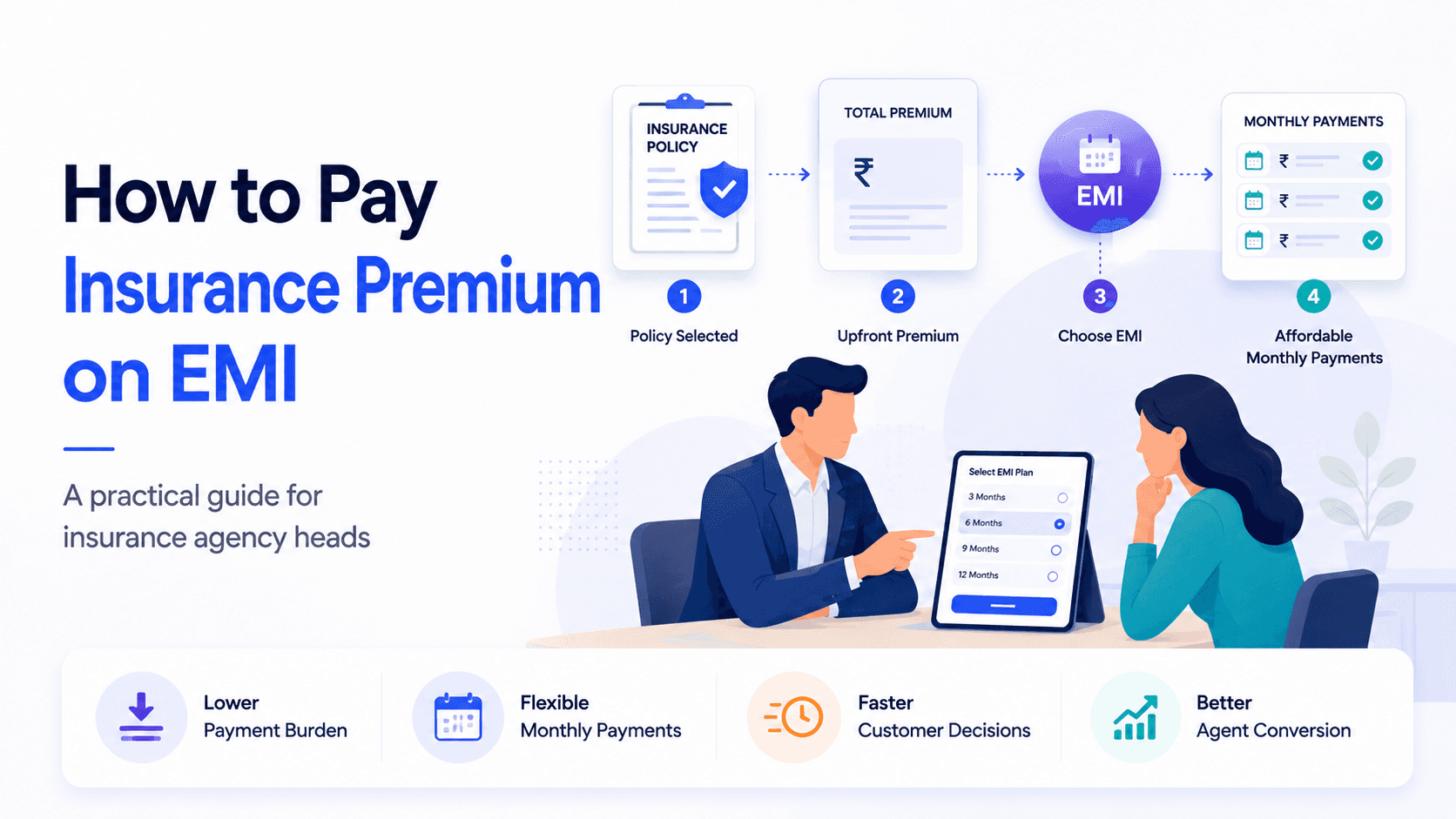
1. The customer is quoted the full annual premium.
2. Instead of paying it upfront, the customer applies for financing through a lending partner.
3. The lender evaluates eligibility based on its own credit criteria.
4. On approval, the lender disburses the full premium amount to the insurer.
5. The customer repays the lender in monthly instalments over an agreed tenure.
4. Who Provides the Financing?
Financing is provided by banks, NBFCs, or specialised lending partners — not by the insurer and not by the agent or agency. The insurer’s and agency’s role is typically limited to making the option available at the point of sale and facilitating the eligibility check; the actual credit decision and repayment relationship sit with the lender.
5. What Does the Insurer Receive?
The insurer receives the complete premium amount, in full, at the time of policy issuance — exactly as it would if the customer had paid in a single lump sum. There is no partial premium or staggered disbursal to the insurer; financing is fully settled between the lender and the insurer before or at policy issuance.
6. What Does the Customer Repay?
The customer repays the lender, not the insurer or the agency, through monthly instalments that typically include the principal premium amount plus an applicable interest or processing cost. This is worth stating plainly to customers upfront, since the total repayment amount will usually be somewhat higher than the original premium — transparency here protects trust in both the agent and the financing option.
7. How EMI Can Help Agents Address Affordability Objections
Affordability objections are among the hardest for agents to handle well, because pushing too hard on value can come across as dismissive of a genuine cash-flow constraint, while backing off entirely can lose the sale. A financing option gives agents a third path: acknowledge the constraint directly, and offer a concrete way to address it, without changing the recommendation or discounting the product.
8. Why Agency Heads Should Enable Agents With Financing Options
Left to individual initiative, EMI usage tends to be inconsistent — some agents use it well, most don’t use it at all, and a few misuse it by overpromising approval. Standardising how and when financing is introduced, and building it into training and scripts rather than leaving it as optional knowledge, is what turns it into a reliable part of the agency’s sales process rather than a feature that quietly goes unused.
9. Where Premium Financing Fits Into the Agent Sales Funnel
Financing fits most naturally right after the premium is quoted and before the customer has time to disengage — not as a last-resort mention after an objection has already been raised, and not as an opening pitch before the product’s value has been established. The moment the number is said out loud is the moment affordability becomes real for the customer, and that’s the moment financing should enter the conversation.
10. What Can Go Wrong With a Poor Financing Journey?
A Good EMI Journey Should Not Create Another Sales Problem
A financing option that is difficult to use can end up costing more sales momentum than it saves. Common friction points agency heads should watch for:
Slow eligibility checks that lose the customer’s attention
Low approval rates that create false expectations
Excessive documentation that feels disproportionate to the loan size
Multiple redirects between apps, links, or platforms
Poor agent visibility into where a customer’s application stands
Unclear EMI terms that surface late in the process
Customer drop-offs mid-application, with no easy way to resume
Lack of lender choice, limiting who can actually get approved
Poor customer support once the loan is active
Financing only becomes a genuine sales asset if the overall journey is simple, fast, and transparent end to end. A clunky process can turn a promising conversation into a worse experience than if EMI had never been mentioned.
11. What Agency Heads Should Evaluate Before Choosing a Partner
Approval rate across a representative customer base
Lender coverage — how many lending partners are available, and for which customer profiles
Eligibility experience — how fast and how simple the check is for the customer
Turnaround time — from application to disbursal
Digital KYC capability — to avoid physical paperwork delays
Customer experience — clarity of terms, communication, and support
Agent experience — how easily agents can initiate and track the process
Integration capability — how well the financing flow fits into existing agent tools
Reporting — visibility into adoption, approval, and conversion metrics
Customer support — quality and responsiveness post-disbursal
Compliance — adherence to relevant lending and disclosure norms
FAQs
Q1. Can I get a loan to pay my insurance premium?
In many cases, yes — subject to eligibility and the availability of a financing partner for that specific policy or insurer.
Q2. Who approves the loan for premium EMI?
The lending partner — a bank, NBFC, or similar institution — approves the loan based on its own credit criteria, not the insurer or the agency.
Q3. Does the insurance policy get delayed if I choose EMI?
Not necessarily. In a well-integrated process, the loan is disbursed and the policy issued within a short turnaround, often the same day, though this depends on the specific lender and process.
Q4. Is there an extra cost to paying premium through a loan?
Usually yes — premium financing typically includes an applicable interest or processing cost, so the total amount repaid is generally higher than the original premium.
Q5. What happens if I can’t repay an EMI on time?
This affects the customer’s obligation to the lender directly, including potential late fees or credit impact, and should be explained clearly by the agent before the customer commits.
Q6. Can agents guarantee EMI approval to customers?
No. Agents should present EMI as an option to explore, always subject to eligibility, and should never imply guaranteed approval.
Conclusion
Helping a customer get a loan to pay their insurance premium on EMI is, in practice, a way of removing one specific obstacle — a large one-time payment — from a sale that has already been substantively won on product fit and trust. It is not a discount, not a guarantee, and not a substitute for a well-built financing journey. For agency heads, the real work isn’t just making financing available; it’s making sure the process behind it is fast, transparent, and reliable enough that offering it never becomes a new source of friction in its own right.
Related reads

Loan on EMI for Insurance Premium: How Agency Leaders Can Help Agents Close More Policies
The premium amount is often the last objection standing between an agent and a closed policy. Here's how framing it as a loan on EMI — insurance premium financing — can change the sales conversation, and what agency leaders should measure to know if it's working.
How to Pay Insurance Premium on EMI: A Guide for Agency Heads
A clear guide for insurance customers on how to pay insurance premium on EMI, written for insurance agency and distribution leaders looking to reduce affordability friction and improve agent conversion.

Understanding Premium Financing Platforms in India: A 2026 Guide for Insurance Companies
A comprehensive guide for insurers evaluating premium financing platforms in India, covering financing models, approval structures, and how centralized platforms improve insurance conversions.

Why Renewal Drop-Offs Are an Affordability Problem, Not a Loyalty Problem
Insurance Policy Renewal lapses often get blamed on loyalty, but the real cause is usually cash-flow timing. Here's why premium financing and multi-lender eligibility checks protect persistency, CAC, and higher sum assured policies.