

How Insurance Agents Can Sell More Policies by Offering EMI on Insurance Premium
An agent has spent time understanding a customer’s needs, explaining the policy, answering questions and building confidence in the product.
The customer likes the policy.
The coverage makes sense.
There is no major objection to the insurer or the benefits.
Then the customer asks one question:
“How much do I have to pay?”
When the premium is higher than the customer expected, the conversation can quickly change. The customer may say they need some time, compare other options, reduce the coverage or simply postpone the decision.
For an insurance agent, this can be frustrating because the customer has not necessarily rejected the policy. They may simply be uncomfortable paying the entire premium at once.
This is where EMI for insurance premium can become an important sales-enablement tool.
Instead of discussing only the total annual premium, agents can give eligible customers another way to manage the payment. By offering EMI on insurance premium, an agent can potentially make higher-value policies more affordable, address payment-related objections and create another opportunity to convert an interested customer.
For insurance businesses, this is bigger than adding another payment option. It can become part of the sales strategy across new policy acquisition, higher-ticket policies and customer affordability conversations.
Why Premium Affordability Becomes a Sales Problem
Insurance is a product customers buy for long-term financial protection. Yet the payment decision is often immediate.
A customer may understand why they need:
Higher health insurance coverage
Family health insurance
Life insurance protection
Additional riders
Better policy benefits
A higher sum insured
But understanding the value does not always mean the customer is comfortable paying the entire premium upfront.
This creates an important distinction for insurance sales teams:
A customer can be convinced about the product but not comfortable with the payment.
That distinction matters.
An agent who treats every payment objection as product rejection may simply continue explaining policy benefits. But if the real problem is affordability, more product explanation may not solve the problem.
Consider a simple example.
A family is interested in a health insurance policy with a higher sum insured because they want better protection for all family members. The customer understands the need and agrees that the coverage is appropriate.
However, when presented with the annual premium, the customer says:
“The policy is good, but I cannot pay this much at one time.”
The agent now has two choices.
The first is to reduce the coverage or wait for the customer to arrange the money.
The second is to explore whether the customer is eligible to pay the premium through EMI.
That second option can change the conversation from:
“Can you afford the annual premium?”
to:
“Would a monthly EMI make this premium more manageable for you?”
That is a very different sales conversation.
How EMI Can Change the Insurance Sales Conversation
EMI is often viewed purely as a payment mechanism.
For insurance distribution teams, it can also be viewed as a sales-enablement tool.
When a premium is divided into manageable monthly payments, the customer’s perception of affordability can change.
For example, instead of looking at a premium as one large annual payment, an eligible customer can evaluate it based on a monthly EMI.
The agent is not changing the value of the policy.
The agent is not reducing the premium.
The agent is simply giving the customer another way to manage the payment.
This can be particularly relevant when selling higher-premium policies.
The conversation can move from price to affordability
Imagine an agent selling a comprehensive health insurance policy.
The customer says:
“The premium is too high.”
Rather than immediately offering a lower-cover policy, the agent can understand what the customer means.
Is the policy genuinely outside their budget?
Or is the customer uncomfortable with making the entire payment at once?
If it is the second situation, EMI for policy premium can become relevant.
The agent can explain that eligible customers may have the option to pay the policy premium through EMI, subject to lender eligibility and applicable terms.
This gives the customer another choice without immediately reducing the protection being offered.
How Agents Can Use EMI at Different Stages of the Sales Journey
EMI should not necessarily be introduced only after a customer objects to the premium.
Insurance agencies can train agents to use affordability conversations more strategically.
1. During the initial product discussion
Agents should first establish the customer’s protection needs.
For example:
How many family members need coverage?
What level of health cover is appropriate?
What are the customer’s financial protection requirements?
What policy features are important?
Once the right product is identified, affordability can become part of the conversation.
An agent can mention that eligible customers may have different payment options, including EMI for insurance premium payment.
This prevents EMI from appearing like a last-minute solution.
2. When presenting the premium
Premium presentation is one of the most important moments in the sales journey.
Instead of presenting only:
Annual premium: ₹X
the agent can explain the available payment options where applicable.
For eligible customers, EMI on insurance premium payment can make the payment structure easier to understand.
The objective should not be to push EMI to every customer.
The objective is to make sure that affordability does not become an unnecessary barrier for a customer who is otherwise interested in the policy.
3. When the customer raises an affordability objection
This is the most obvious use case.
When a customer says:
“I need to think about the premium.”
the agent should understand the reason.
If the concern is affordability, EMI can be introduced as one possible solution.
A simple conversation could be:
“If the policy and coverage work for you, we can also check whether you are eligible to pay the premium through EMI. That may make the payment easier to manage.”
This keeps the conversation focused on solving the customer’s concern rather than immediately negotiating the policy down.
4. During follow-ups
Customers often say they will decide later.
Agents can use follow-ups to understand what is holding the customer back.
If the policy is suitable but the premium remains the concern, an EMI for policy premium payment option can give the agent another reason to restart the conversation.
This can be especially useful for leads that are interested but have not yet converted.
5. During higher-ticket policy conversations
The higher the premium, the more relevant payment flexibility can become.
This does not mean every high-premium customer needs EMI.
It means agents should have the option available when affordability becomes a barrier.
This can help agencies protect the original recommendation rather than automatically moving customers towards lower-value policies simply because the upfront premium feels high.
EMI for Health Insurance Premium Payment
Health insurance is one category where premium affordability can become particularly relevant.
Customers may want comprehensive coverage but hesitate when the premium increases because of:
Larger sum insured
Family coverage
Multiple family members
Additional benefits
Higher coverage requirements
Changes in premium at renewal
For example, a customer may initially consider basic individual coverage but realise that a family policy with higher coverage provides better protection.
The more comprehensive policy may also have a higher premium.
At this point, the customer has a choice between reducing coverage or finding a way to manage the premium.
EMI for health insurance premium payment can provide another option for eligible customers.
Example: Family health insurance
Consider a family of four looking for health insurance.
The agent recommends a policy with adequate coverage for the entire family rather than focusing only on the lowest premium.
The customer likes the recommendation but hesitates at the premium.
Instead of immediately moving to a lower-cover policy, the agent can explain the possibility of EMI on health insurance premium payment, subject to eligibility.
This can help keep the conversation focused on the customer’s actual protection needs.
The key lesson for agency leaders
EMI should not be positioned as a way to sell customers more insurance than they need.
It should be positioned as a way to give customers payment flexibility when the recommended policy is suitable but the upfront payment creates friction.
That distinction is important for responsible insurance selling.
EMI for Life Insurance Premium Payment
Life insurance can involve larger premium commitments, particularly for policies where customers are looking for significant financial protection.
Here too, affordability can influence the final decision.
A customer may understand the need for life insurance but hesitate when they see the premium they need to pay.
An agent offering EMI for life insurance premium payment can introduce payment flexibility into that conversation.
For example:
A customer wants a higher level of financial protection for their family but feels uncomfortable with the annual premium.
Instead of immediately reducing the coverage, the agent can explore whether the customer is eligible for EMI.
This allows the customer to consider the policy based on its long-term value while also considering a payment structure that may be easier for them to manage.
Keep the conversation about protection
One important principle for agents is not to turn the conversation into a discussion purely about monthly payment.
The customer’s insurance need should remain central.
A good sales conversation is:
Need → Appropriate coverage → Premium → Payment options
rather than:
Monthly EMI → Product
EMI should support the insurance recommendation, not replace the need-based selling process.
How Insurance Agencies Can Enable Agents to Sell With EMI
For EMI to become useful at an agency level, simply making it available is not enough.
Agents need to know when, how and to whom they should introduce it.
Here are some practical steps agency leaders can take.
1. Train agents to identify affordability objections
Agents should be trained to distinguish between:
“I don’t need this policy.”
and
“I need this policy, but I am not comfortable paying this much at once.”
The second situation can potentially be addressed through payment flexibility.
2. Give agents a simple EMI explanation
Agents should not need to explain complicated lending processes.
A simple explanation could be:
“If you are eligible, you can choose to pay the premium through EMI. We can check your eligibility and show you the available options.”
The simpler the explanation, the easier it is for agents to use consistently.
3. Make the eligibility process easy
An agent should not have to navigate a complicated process while trying to close a policy.
An EMI eligibility check by filling one form can make the process easier for both the agent and customer.
The objective should be to minimise friction between the customer’s interest in EMI and the actual eligibility check.
4. Provide multiple financing options
A single lender may not be suitable for every customer.
Insurance businesses looking to introduce EMI should consider solutions that provide access to multiple lenders and multiple banks and NBFCs.
This can potentially improve the chances of finding an eligible option for different customer profiles, subject to lender policies.
5. Offer flexible tenure options
Customers can have different cash-flow preferences.
A suitable EMI solution can offer repayment options across:
6, 9, 12, 18, 24 and 30 months
The appropriate tenure should depend on customer eligibility, lender terms and the customer’s financial circumstances.
6. Track where EMI actually helps
Agency leaders should not assume that EMI will have the same impact across every policy segment.
Instead, measure it.
For example, compare:
Policies where EMI was offered
Policies where EMI was not offered
Conversion rates
Average premium
EMI adoption
High-value policy conversion
Follow-up conversion
Premium collection
Over time, this can show which customer segments and policy categories benefit most from payment flexibility.
What Insurance Leaders Should Measure
If EMI is being introduced as part of the agency sales process, it should be measured like any other sales-enablement initiative.
Some useful KPIs include:
1. Lead-to-policy conversion
Are more qualified leads converting when EMI is available?
2. Quote-to-policy conversion
Does offering payment flexibility help customers move from quotation to purchase?
3. Average premium per policy
Is EMI helping agents retain the recommended policy rather than moving customers to lower-premium alternatives?
4. EMI adoption rate
Among eligible customers, how many actually choose EMI?
5. High-value policy conversion
Are customers with higher premiums converting at a better rate when payment flexibility is available?
6. Follow-up-to-conversion rate
Does EMI give agents an additional tool to convert customers who were previously undecided?
7. Premium collection
Does the availability of additional payment options help improve premium collection?
8. Agent productivity
Are agents spending less time repeatedly following up with customers who have an affordability concern?
The goal is not simply to increase EMI transactions.
The larger objective is to determine whether payment flexibility is helping the agency improve the overall sales journey.
What Should a Good EMI Solution Offer?
From an insurance business perspective, the customer and agent experience matters as much as the availability of EMI.
A useful solution should ideally provide:
Multiple lenders
Different customers may have different eligibility profiles. Access to multiple lenders can provide more financing options.
Multiple banks and NBFCs
A broader lender network can potentially improve choice and accessibility, subject to individual lender eligibility.
Multiple EMI tenures
Customers may need different repayment periods. Options such as 6, 9, 12, 18, 24 and 30 months can provide greater flexibility.
Simple eligibility checking
The process should be easy for agents to initiate.
An EMI eligibility check by filling one form can make it easier to determine whether a customer qualifies for an available financing option.
A simple agent experience
Agents should be able to explain EMI without becoming financing experts.
A smooth customer experience
The customer should be able to understand the available payment option, eligibility requirements and applicable terms clearly before proceeding.
How ShopSe Can Help Insurance Businesses Enable EMI
Insurance businesses looking to make payment flexibility part of their sales process can consider an affordability platform such as ShopSe.
ShopSe helps businesses offer EMI options through multiple lenders, banks and NBFCs, giving eligible customers access to different financing options.
For insurance premium payments, the platform supports EMI repayment options across 6, 9, 12, 18, 24 and 30 months, depending on applicable lender and customer eligibility.
The EMI eligibility process can also be initiated by filling one form, helping agents introduce payment flexibility without adding a complicated process to the sales journey.
For insurance businesses, the larger opportunity is not simply “offering EMI.”
It is giving agents another tool to address a specific sales barrier: the customer wants the policy, but the upfront premium feels difficult to manage.
The Bigger Opportunity for Insurance Agency Leaders
Insurance agents already have several tools to improve sales: better prospecting, stronger product knowledge, structured follow-ups, customer segmentation and need-based selling.
Payment flexibility can be another tool in that toolkit.
When a customer rejects a policy because they do not see its value, EMI may not solve the problem.
But when a customer sees the value and the real barrier is the upfront premium, EMI for insurance premium can create another path to conversion.
For health insurance, it can help customers consider comprehensive coverage without immediately focusing only on the lowest premium.
For life insurance, it can help agents address affordability concerns around higher-premium policies.
For agency leaders, it can provide another lever to improve the effectiveness of sales conversations.
And for businesses, the potential outcomes are meaningful:
More policy sales.
More conversions.
Higher premium collection.
The key is to treat EMI not as a standalone payment feature, but as part of a broader affordability-led insurance sales strategy.
When agents have the right product, the right customer conversation and the right payment options, an affordability objection does not necessarily have to become a lost sale.
Related reads
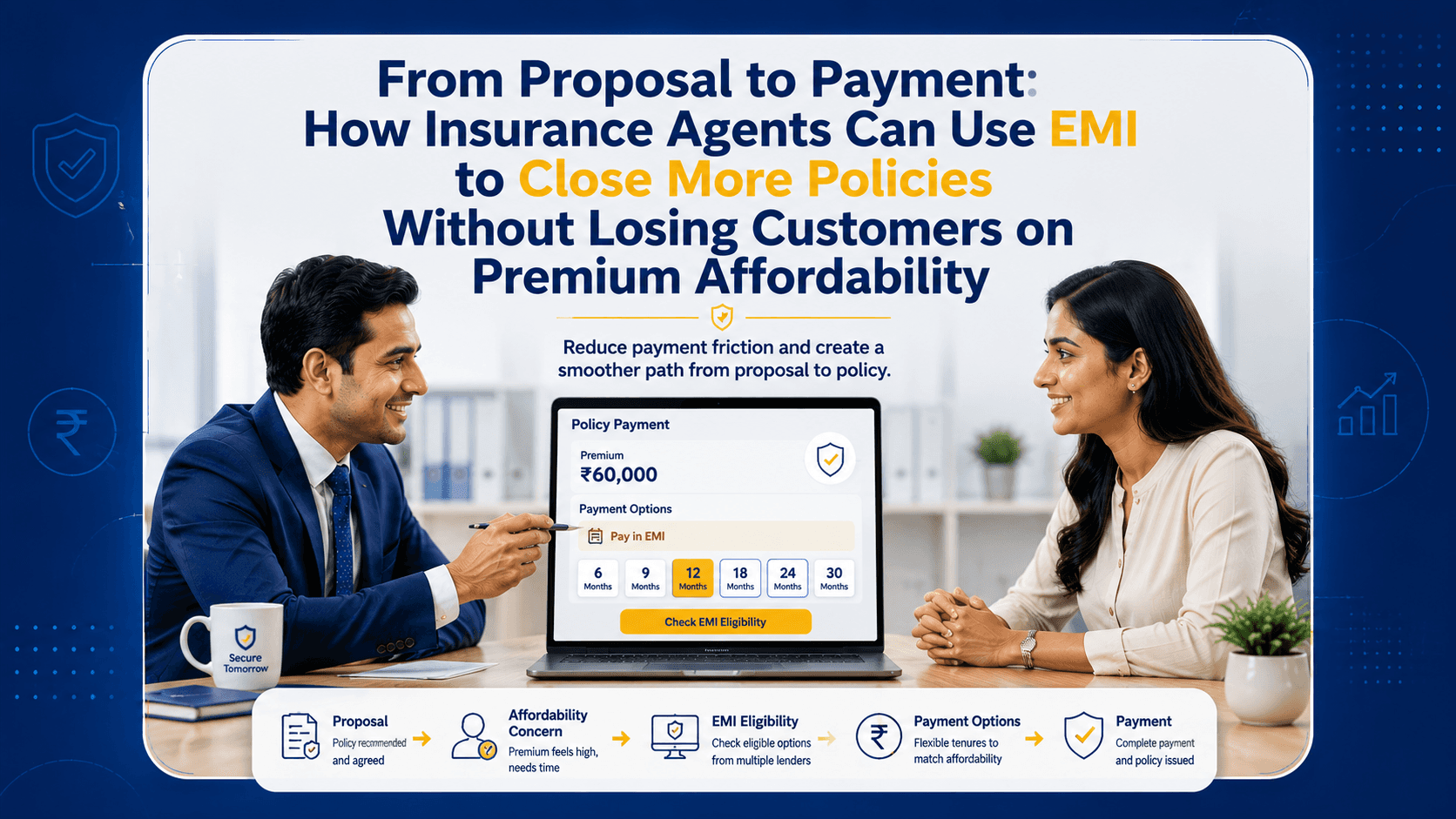
From Proposal to Payment: How Insurance Agents Can Use EMI to Close More Policies Without Losing Customers on Premium Affordability
Learn how insurance agents can use EMI as a payment option to address premium affordability concerns, reduce payment friction and create a smoother path from proposal to policy.

Understanding Premium Financing Platforms in India: A 2026 Guide for Insurance Companies
A comprehensive guide for insurers evaluating premium financing platforms in India, covering financing models, approval structures, and how centralized platforms improve insurance conversions.

Multiple Lenders, One Form: How Insurance Agents Can Give Customers More EMI Options With a Single Eligibility Check
Learn how access to multiple lenders, banks and NBFCs through one simple eligibility check can help insurance agents simplify EMI conversations and give customers more payment options.

Insurance Premium Financing in India: How EMI Increases Policy Conversions for Insurers
Learn how insurance premium financing and zero down payment EMI help insurers increase policy conversions, improve average ticket size, and accelerate revenue growth without increasing acquisition costs.