How Premium Financing Helps Sales Managers Reduce Policy Porting


For insurance sales managers, acquisition is only half the battle.
Retention is where long-term performance is truly defined.
Every renewal season brings a familiar challenge. Customers who were successfully onboarded a year ago begin evaluating alternatives again. Competitors enter conversations. Premium comparisons start. Agents scramble to retain business that once seemed secure.
Policy porting becomes an annual cycle.
While insurers often attribute porting to pricing or competition, the underlying trigger is frequently more practical.
Renewal is a financial decision moment.
And the way customers experience that payment moment plays a larger role in retention than many teams realize.
The Reality Behind Policy Porting
Customers rarely port insurance policies purely because they are dissatisfied.
In many cases, coverage experience has been acceptable. Claims may not even have occurred. Service quality may not be in question.
Yet at renewal, customers begin reconsidering their choices.
Why?
Because renewal resets commitment.
The policy that once felt like a long-term decision suddenly becomes a fresh purchase evaluation. Customers compare premiums, explore competing offers, and reassess affordability.
Common triggers include premium increases, cash flow constraints, or simply the discomfort of making another large lump sum payment.
Porting, in many situations, is not a service problem.
It is an affordability moment.
Renewal Payment Shock and Decision Fatigue
At the time of initial purchase, customers are emotionally invested. They understand risk, protection, and long-term security.
At renewal, the mindset changes.
The renewal premium appears as a standalone expense competing with other financial priorities. Even loyal customers hesitate when faced with a significant upfront payment.
This hesitation opens the door to competitors.
A rival insurer offering slightly lower premiums or flexible payment options suddenly becomes attractive, even if switching involves effort.
For sales managers, this creates last-minute retention pressure. Teams spend valuable time defending existing business instead of expanding new opportunities.
The renewal conversation becomes reactive rather than strategic.
How Premium Financing Changes Renewal Behaviour
Premium financing fundamentally alters how customers experience renewal.
Instead of facing a lump sum payment, customers can renew policies through structured EMI options. The financial decision shifts from a one-time burden to a manageable monthly commitment.
This change may appear operational, but its behavioral impact is significant.
When affordability pressure reduces, customers are less likely to reopen comparison discussions. Renewal feels like continuity rather than reconsideration.
Premium financing maintains payment comfort across policy years, helping customers stay within familiar financial patterns.
As a result, renewal decisions happen faster and with less resistance.
The conversation moves away from price negotiation toward coverage continuity.
Continuity Reduces Switching Intent
One of the strongest drivers of porting is disruption.
When customers must reorganize finances annually to pay premiums, each renewal becomes an opportunity to reassess alternatives.
Premium financing reduces this disruption.
EMI-based renewals create continuity in payment behavior. Customers integrate insurance payments into their monthly financial planning instead of treating renewal as a large annual expense.
This continuity weakens the psychological trigger to switch providers.
For sales managers, fewer customers enter active comparison mode. Retention improves not through persuasion, but through reduced friction.
Multi-Year Policies Strengthen Retention Further
Premium financing becomes even more powerful when combined with multi-year insurance policies.
Longer tenure policies reduce the number of renewal decision points altogether. When customers commit to two or three years of coverage supported by financing, competitive entry opportunities shrink.
Instead of defending renewals every year, sales teams gain longer stability windows.
This allows managers to focus on relationship building, cross-selling, and portfolio expansion rather than repeated retention firefighting.
Multi-year adoption supported by premium financing effectively converts annual retention battles into sustained customer relationships.
A Practical Advantage for Sales Teams
For sales managers overseeing large agent networks, renewal efficiency directly affects productivity.
Premium financing provides teams with a practical retention tool.
Agents can initiate renewal discussions earlier, presenting EMI options proactively rather than negotiating under deadline pressure. Affordability objections reduce, and conversations become solution-oriented.
The result is a smoother renewal cycle.
Sales teams spend less time recovering at-risk customers and more time pursuing incremental growth opportunities.
Retention becomes structured rather than dependent on last-minute intervention.
The Revenue Impact of Reduced Porting
Lower policy porting has measurable business outcomes.
Improved retention strengthens persistency ratios and stabilizes renewal books. Customer acquisition costs decline because fewer policies need replacement each year.
Revenue predictability improves, enabling better planning across distribution and operations.
From a leadership perspective, preventing policy loss is often more efficient than acquiring new business.
Premium financing supports this by protecting existing revenue rather than chasing replacement volume.
Premium Financing as Retention Infrastructure
Insurance premium financing is often viewed primarily as a conversion tool for new sales.
Its strategic value extends further.
By reducing renewal payment friction and supporting affordability continuity, premium financing acts as retention infrastructure.
It helps sales managers protect portfolios, maintain customer relationships, and minimize unnecessary switching driven by payment discomfort rather than dissatisfaction.
In an increasingly competitive insurance landscape, retention advantage can be as important as acquisition capability.
The insurers that integrate premium financing across both acquisition and renewal journeys position their sales teams to succeed not just in closing policies, but in keeping them.
Because ultimately, sustainable growth in insurance does not come only from selling more policies.
It comes from keeping more of the ones already sold.
Insurers evaluating premium financing platforms can refer to our detailed platform guide.
Related reads

How EMI on Insurance Premium Can Help Insurance Agencies Convert Customers During the Grace Period
How insurance agencies can use EMI as an additional payment option to help customers facing premium affordability challenges during the grace period.

Renewals vs New Policies: Why Affordability Determines Insurance Growth
Explore how affordability impacts insurance renewals vs new policies and how premium financing helps insurers improve renewal retention, reduce policy churn, and drive sustainable growth.

How Premium Financing Helps Insurers Sell More Multi-Year Policies
Discover how premium financing for multi-year insurance and 3 year health insurance EMI structures help insurers increase lifetime value, improve retention, and drive higher multi-tenure adoption.
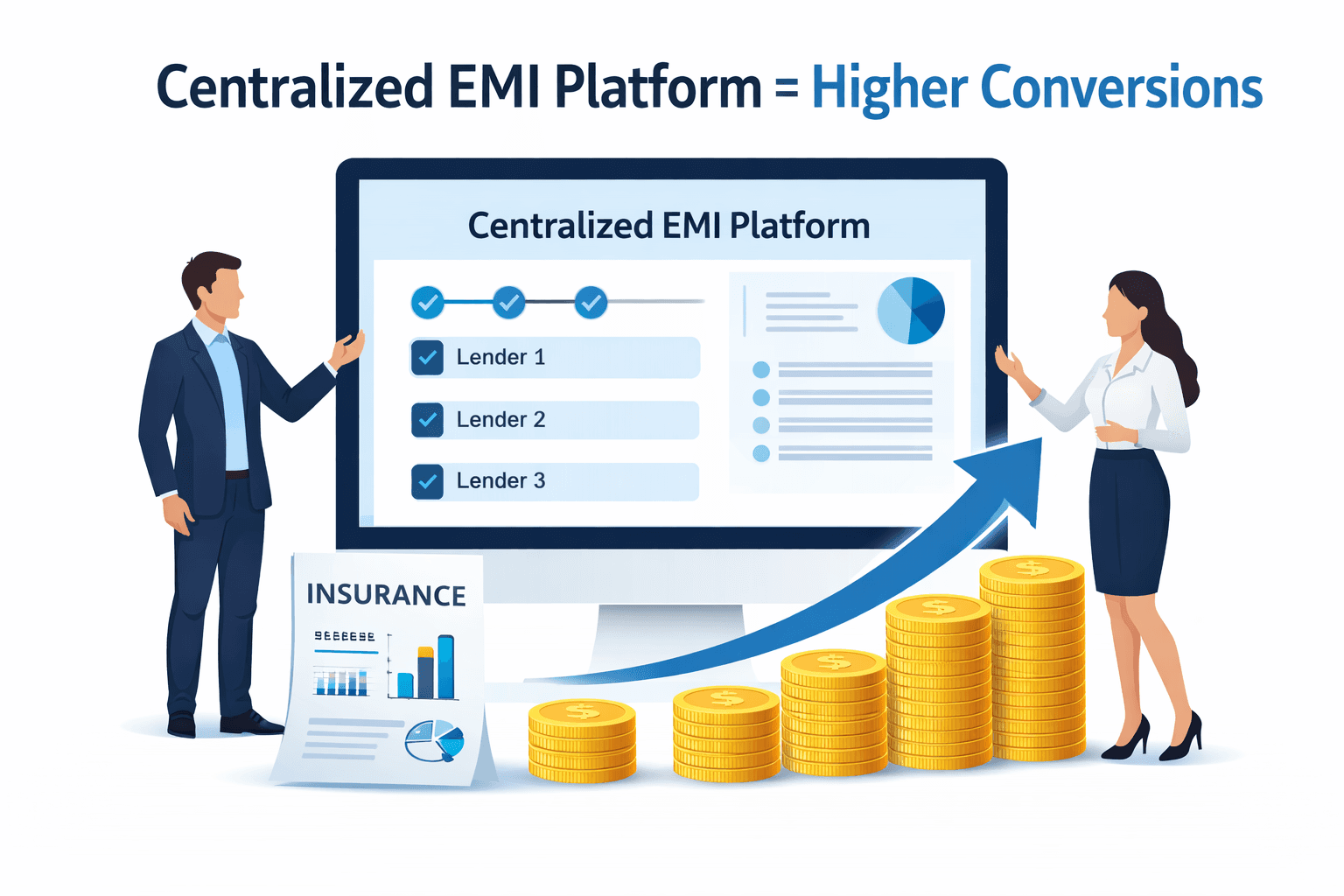
How a Single EMI Platform Helps Insurance Sales Managers Improve Conversions and Reduce Policy Drop-Off
Discover how a centralized EMI platform with multiple payment options helps insurance sales managers increase policy conversions, reduce drop-offs, and accelerate team target achievement.