How to Pay Insurance Premium on EMI: A Guide for Agency Heads

ShopSe Digital Finance
Aug 21, 2026
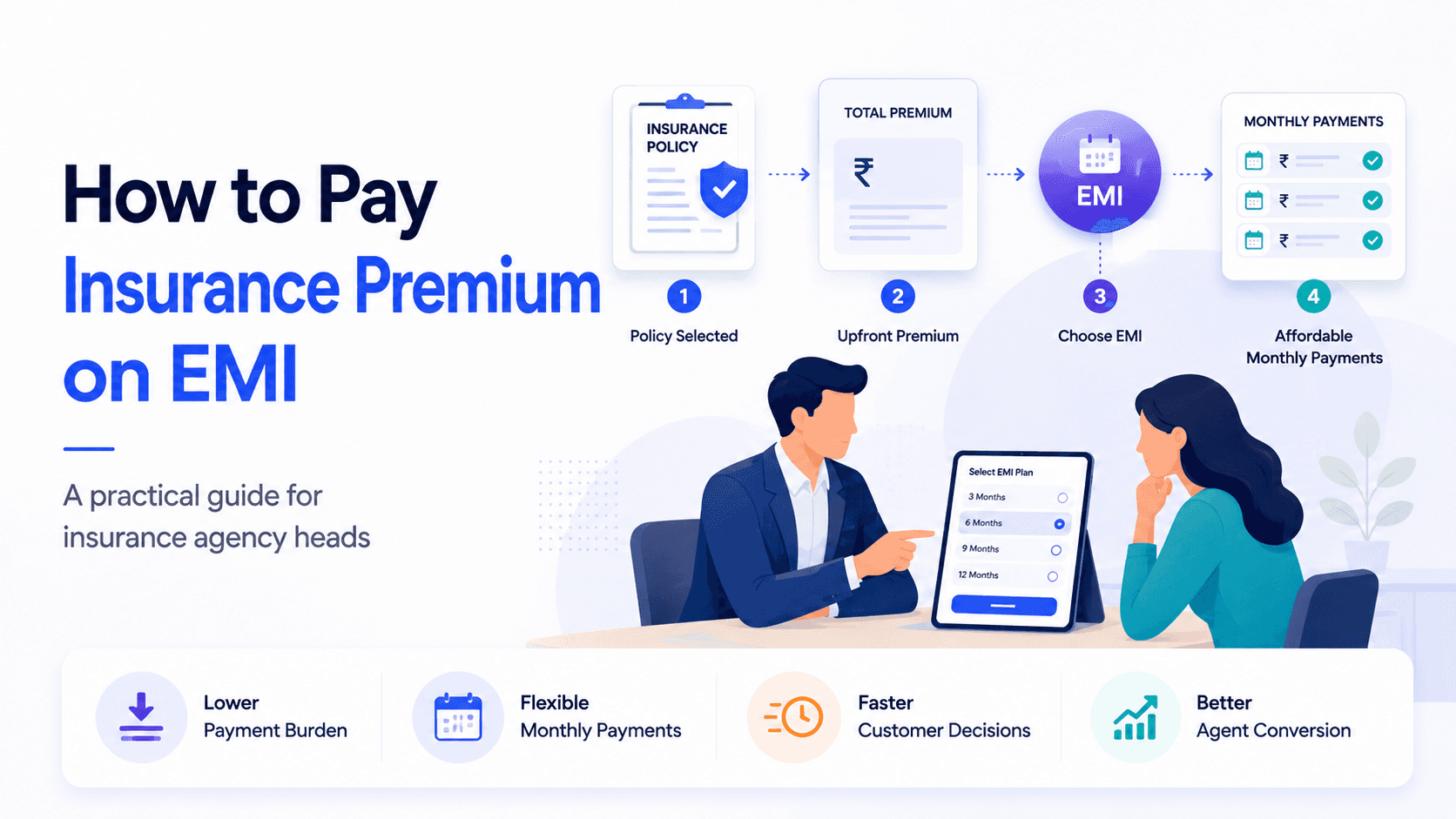
How to Pay Insurance Premium on EMI: A Guide for Insurance Agency Heads
1. Can You Pay an Insurance Premium on EMI?
Yes — in most cases, an insurance premium can be paid through EMI, provided the customer is eligible for financing and a lending partner is available to fund the premium. This is the question behind a growing number of searches, and it is also the question agents hear in some form almost every time a premium crosses a certain size.
The short answer is straightforward. The more useful answer, for anyone leading an agency, distribution vertical, or branch team, is understanding how to pay insurance premium on EMI in a way that agents can explain accurately, customers can trust, and that actually helps move a sale forward rather than adding a confusing extra step.
This article walks through what premium EMI means, how the process works end to end, and what agency heads specifically should be thinking about when they decide whether — and how — to build this into their agent sales process.
2. What Does Insurance Premium EMI Mean?
Insurance premium EMI refers to paying an insurance premium — usually an annual or lump-sum amount — through monthly instalments rather than as a single upfront payment. This is done through a short-term loan, commonly called premium financing, taken from a bank, NBFC, or similar lending partner.
It’s worth being precise about what this is and isn’t:
It is not a discount. EMI does not reduce the total premium. It restructures when and how the customer pays it.
It is not automatic. Financing is subject to the customer’s eligibility as assessed by the lender.
It does not change the policy. The insurer receives the full premium at inception and the policy is issued in full, exactly as it would be with a lump-sum payment.
3. How Does a Premium Loan Work?
A premium loan follows a fairly standard credit structure, even though the end customer may just think of it informally as “paying premium on EMI”:
1. The customer selects a policy and the insurer calculates the total premium.
2. Instead of paying the full amount, the customer applies for financing through a lending partner.
3. The lender assesses eligibility using standard credit checks.
4. If approved, the lender pays the full premium to the insurer directly.
5. The customer repays the lender in monthly instalments, typically over 3 to 12 months, usually with an applicable interest or processing cost built into the EMI.
The insurer’s side of this transaction ends the moment the premium is received. Everything from that point — repayment, tenure, any applicable charges — sits between the customer and the lender.
4. Step-by-Step: How a Customer Can Pay Premium Through EMI
From the customer’s point of view, the practical journey usually looks like this:
1. Choose the policy and get the final premium quote.
2. Ask about, or be offered, the EMI option by the agent.
3. Share basic details for a quick eligibility check.
4. Review the EMI amount and tenure options presented.
5. Select a tenure and complete the loan application.
6. On approval, the lender pays the insurer and the policy is issued.
7. The customer repays the loan through scheduled monthly instalments.
The fewer redirects and delays between steps 2 and 5, the more likely a customer is to complete the process instead of abandoning it midway — a point agency heads should treat as an operational priority, not a minor detail.
5. What Happens After EMI Eligibility Is Confirmed?
Once eligibility is confirmed, the process is largely a formality from the agent’s perspective: the customer sees the EMI amount for their chosen tenure, agrees to proceed, and completes any remaining documentation the lender requires (often digital KYC). The insurer issues the policy once the lender confirms the premium has been paid — this typically happens on the same day or within a short turnaround window, so the sale does not have to stall waiting for the loan to be disbursed.
For agents, this stage is worth understanding well, because customer questions at this point are usually about certainty — “will my policy start today”, “what if I miss an EMI” — and having clear, accurate answers ready prevents last-minute hesitation.
6. Why Customers May Prefer Monthly Payments for Larger Premiums
Larger annual premiums — commonly seen in health, life, and term insurance — represent a significant one-time cash outflow, even for customers who are financially comfortable overall. A ₹50,000 annual premium and a ₹4,200 monthly instalment are the same total cost, but they are not evaluated the same way by most households, because monthly cash flow and annual savings are managed differently.
This is why premium EMI tends to be most relevant precisely where agents see the most stalling: higher-ticket policies, first-time buyers without a habit of setting aside a lump sum for insurance, and customers who are comparing multiple financial commitments (school fees, EMIs on other loans, festival expenses) around the same time.
7. Why Agents Should Introduce EMI Before the Final Payment Stage
A common and avoidable mistake is treating EMI purely as a fallback — something mentioned only after a customer has already said “let me think about it”. By that point, the customer has often mentally disengaged, and a follow-up call days later has a much lower chance of reviving the conversation.
Introducing EMI in the same breath as the premium quote — “your premium is ₹X; if eligible, you can also pay this through EMI” — keeps the customer in the conversation and lets any real affordability concern surface immediately, while the agent still has the customer’s attention.
8. Fresh Policy vs Renewal: Where EMI May Be Relevant
EMI is most naturally relevant to fresh, higher-ticket policies where the premium is being evaluated for the first time and affordability is an open question. Renewals are a more nuanced case: an existing customer already has a payment history and a relationship with the policy, so affordability objections are less frequent — though EMI can still be useful for customers renewing into a higher sum-insured tier, or where the premium has increased meaningfully at renewal.
Agency heads deciding where to prioritise agent training should weight fresh, high-ticket sales more heavily than routine renewals, at least initially.
9. How Agency Heads Can Build EMI Into the Sales Process
Making EMI available in the background does not automatically translate into agents using it well. A few practical steps help:
Standardise the pitch timing. Train agents to mention EMI at the point of quoting, not after an objection.
Keep the language simple and accurate. “Subject to eligibility” should be part of every mention, never implied optimism.
Make eligibility checks fast. A check that takes hours loses the moment of customer interest.
Track usage, not just availability. Knowing EMI exists is different from agents actually offering it consistently.
10. Questions Agency Leaders Should Ask an EMI/Financing Partner
What is the typical approval rate across our customer base?
How long does an eligibility check take, end to end?
What tenures and EMI amounts are typically offered?
What documentation does the customer need to provide?
How is the process integrated into the agent’s existing workflow?
What reporting is available to track adoption and conversion?
What happens if a customer misses an instalment — and does that affect the agency or only the customer?
11. FAQs
Q1. Can I pay my insurance premium on EMI?
In most cases, yes — subject to eligibility and the availability of a financing partner for that policy or insurer.
Q2. Is EMI available for all insurance policies?
It typically applies to policies with meaningful annual premiums, such as health, life, and term insurance, and depends on the specific financing partnerships in place.
Q3. Does paying premium on EMI cost more than paying upfront?
Financing usually carries an applicable interest or processing cost, so the total repayment is generally higher than the one-time premium. Customers should review the exact terms before proceeding.
Q4. Does the insurance company approve the EMI, or the lender?
The lender approves the loan based on its own eligibility criteria. The insurer’s role is limited to receiving the premium and issuing the policy.
Q5. What happens to my policy if I stop paying the EMI?
The policy itself is unaffected by loan repayment, since the insurer already received the full premium. However, missed EMI payments affect the customer’s obligation to the lender and their credit standing, so this should be explained clearly upfront.
Q6. Can agents offer EMI for insurance premium?
Yes, agents can inform customers about the EMI option and initiate an eligibility check, though final loan approval rests with the lending partner.
Q7. Is insurance premium financing available in India?
Yes, several banks and NBFCs offer premium financing in India, typically integrated through the insurer, agency, or a distribution platform.
Q8. How long does it take to get premium EMI approved?
This varies by lender, but a well-integrated digital process can often return an eligibility decision within minutes to a few hours.
Conclusion
Paying an insurance premium on EMI is, at its core, a financing decision layered on top of an insurance decision — and the two should not be confused. It does not make a policy cheaper, and it is not guaranteed for every customer. What it does is give customers a second, more manageable way to fund a payment they had already decided to make, and it gives agents a legitimate, honest answer to one of the most common reasons a sale stalls at the finish line.
For agency heads, the opportunity is less about the financing product itself and more about how consistently, clearly, and honestly it is built into the agent’s everyday sales conversation.
Related reads

Loan on EMI for Insurance Premium: How Agency Leaders Can Help Agents Close More Policies
The premium amount is often the last objection standing between an agent and a closed policy. Here's how framing it as a loan on EMI — insurance premium financing — can change the sales conversation, and what agency leaders should measure to know if it's working.

Get Loan to Pay Insurance Premium on EMI: A Guide for Agency Heads
How agency heads can help agents solve the affordability objection by understanding how customers can get a loan to pay insurance premium on EMI, and what to evaluate in a financing partner.

How Insurance Agents Can Sell More Policies by Offering EMI on Insurance Premium
Learn how EMI on insurance premiums can help insurance agents overcome affordability objections, improve policy conversions and potentially increase premium collection.

Insurance Premium Financing in India: How EMI Increases Policy Conversions for Insurers
Learn how insurance premium financing and zero down payment EMI help insurers increase policy conversions, improve average ticket size, and accelerate revenue growth without increasing acquisition costs.