How Checking Customer EMI Eligibility Before Creating a Proposal Can Help Insurance Agents Improve Conversions


An insurance agent has a promising customer.
The customer has shared their requirements. The agent understands the family situation, coverage expectations and budget. After a detailed discussion, the agent recommends a suitable policy.
The proposal is prepared.
The benefits are explained.
The customer likes the policy.
Then comes the premium.
The customer looks at the amount and says:
“The policy looks good, but I don’t think I can manage this premium right now.”
The agent has now reached an objection that could have been identified much earlier.
The problem may not be the insurance product. The customer may actually want the coverage. The problem may simply be how they will manage the premium payment.
This is where an early EMI eligibility check can potentially make the insurance sales process more efficient.
The idea is simple:
Do not wait until the customer likes the policy to discover that premium affordability is the problem.
This does not mean EMI eligibility should determine which insurance product a customer buys. Insurance need, suitability and coverage should always come first.
Instead, where payment affordability is likely to be relevant, agents can consider EMI eligibility as an additional part of the sales conversation.
For Agency Channel Heads, Sales Heads and Business Heads, this can potentially help create a more complete journey from customer need → suitable policy → premium → payment option → purchase.
The Problem With Discovering Affordability Too Late
Insurance sales often involve considerable effort before the customer reaches the final payment stage.
An agent may:
Prospect the customer
Understand their needs
Collect information
Compare suitable products
Explain coverage
Prepare a proposal
Conduct follow-ups
Address questions
Discuss the premium
Work towards closing
If affordability is discovered only at the end, much of this effort can lead to another round of conversations.
The customer may say:
“Let me think about it.”
Or:
“I will arrange the money and get back to you.”
Or:
“Can you show me something with a lower premium?”
Each response creates another follow-up.
And in some cases, the customer may move to a lower level of coverage simply because the upfront premium feels difficult to manage.
This is where an EMI on insurance conversation can potentially be useful.
The objective is not to push EMI.
The objective is to understand earlier whether payment structure could become a barrier.
Insurance Need and Payment Ability Are Two Different Conversations
One of the most important things for agents to understand is that insurance suitability and payment affordability are separate questions.
The first question is:
What insurance protection does the customer actually need?
The second is:
How comfortable is the customer with managing the premium for that protection?
These questions should not be mixed.
For example, suppose a family needs comprehensive health insurance.
The agent recommends an appropriate policy based on the family’s needs.
The family agrees that the coverage makes sense.
But the premium is higher than what they are comfortable paying upfront.
The agent now has a payment conversation, not necessarily a product conversation.
This is where Health Insurance on EMI can potentially become relevant for an eligible customer.
Similarly, a customer may understand the importance of life insurance and want a higher level of protection, but hesitate when presented with the premium.
Here, Life Insurance on EMI can potentially provide another payment option.
The important principle is:
First determine what the customer needs. Then determine how the customer can comfortably pay for it.
EMI should support that process, not replace it.
How Early EMI Eligibility Can Improve the Sales Conversation
Checking EMI eligibility earlier in the sales process can potentially help agents identify affordability as a consideration before reaching the final stage.
Consider two different sales journeys.
Traditional approach
Customer requirement → Policy recommendation → Proposal → Premium discussion → Affordability objection → EMI discussion
The EMI conversation happens only after the customer has already hesitated.
More structured approach
Customer requirement → Suitable policy → Premium discussion → Payment preference → EMI eligibility where relevant → Proposal/payment
Here, payment affordability becomes part of the conversation earlier.
This does not mean an agent should ask every customer to apply for EMI.
Instead, the agent can recognise situations where payment flexibility may be relevant.
For example:
“Based on your requirements, this is the coverage I would recommend. The premium is ₹X. If paying the full amount at once is a concern, we can also check whether you are eligible for an EMI option.”
This gives the customer another choice without changing the insurance recommendation.
What Does “Insurance on EMI” Actually Mean for an Agent?
Customers may use different terms when talking about this payment option.
They may ask:
“Can I get insurance on EMI?”
“Can I pay the policy premium on EMI?”
“Is there EMI on insurance?”
“Can I pay my health insurance premium in EMI?”
“Can I get life insurance on EMI?”
From an agent’s perspective, these conversations generally point towards the same underlying concern:
The customer wants payment flexibility.
Terms such as EMI on insurance, EMI on insurance premium, EMI on policy premium and Policy Premium on EMI can therefore naturally become part of the sales vocabulary.
The agent does not need to turn the conversation into a detailed explanation of financing.
A simple explanation is often enough:
“If you are eligible, there may be an option to pay the premium through EMI. We can check your eligibility and see what options are available.”
The customer can then decide whether that option is useful to them.
Example 1: Health Insurance
Consider a family looking for health insurance.
The agent understands their requirements and recommends a policy with a higher sum insured because the family wants more comprehensive protection.
The family agrees with the recommendation.
Then they see the premium.
“This is more than we expected. Can you show us a cheaper policy?”
At this point, the agent could immediately reduce the coverage.
But there is another question worth asking:
Is the customer rejecting the coverage, or is the upfront premium the problem?
The agent can say:
“If you are comfortable with the coverage and the main concern is the premium payment, we can also check whether you are eligible for an EMI option.”
If the customer is eligible, EMI on health insurance premium can provide another way to manage the payment.
This can potentially help the agent keep the conversation focused on the customer’s protection needs rather than immediately moving towards a lower-value policy.
Why this matters
The customer may have initially said:
“The premium is too high.”
But what they may actually mean is:
“The upfront payment is too high for me.”
Those are not necessarily the same objection.
An EMI on health insurance option can potentially help the agent address the second one.
Example 2: Life Insurance
Now consider a customer looking for life insurance.
The customer wants meaningful financial protection for their family and agrees that the recommended level of cover is appropriate.
The premium is higher than they expected.
The customer says:
“I understand why I need the policy, but I need some time to arrange the premium.”
Again, the customer has not necessarily rejected the insurance.
The affordability issue has appeared at the payment stage.
The agent can explain:
“If the policy works for your requirements, we can check whether you are eligible for an EMI option for the premium.”
For an eligible customer, EMI on life insurance premium or Life Insurance on EMI can provide another payment route, subject to the applicable financing terms.
The agent is not changing the customer’s insurance requirement.
They are simply exploring whether the payment can be managed differently.
Why Eligibility Before Proposal Can Matter
The benefit of checking EMI eligibility earlier is not only about the customer.
It can also improve the way agents manage their sales pipeline.
1. Better qualification
An agent can understand the customer’s insurance requirement and payment considerations earlier.
This can create a more complete picture of the opportunity.
2. Fewer late-stage surprises
If affordability is likely to be a concern, the agent can address it before spending extensive time on the final stage of the sales process.
3. Better follow-up quality
Instead of repeatedly asking:
“Have you decided?”
the agent can have a more specific conversation:
“Was the premium the concern? If so, would you like me to check whether an EMI option is available?”
That is a more useful follow-up.
4. Better customer experience
Customers do not have to reach the end of the sales process before discovering that another payment option may be available.
5. Potentially better conversions
If the customer’s only barrier is premium affordability, providing another payment option can potentially help move the customer towards purchase.
This should not be treated as a guaranteed conversion improvement.
The impact should be measured by the insurance business using its own customer and sales data.
6. Better agent productivity
A structured payment conversation can potentially reduce repetitive follow-ups and help agents spend more time on qualified opportunities.
A Practical Agent Workflow
Insurance agencies can build a simple process around EMI eligibility.
Step 1: Understand the customer’s insurance need
Start with:
Family structure
Financial protection requirements
Health coverage requirements
Existing insurance
Desired coverage
Relevant policy objectives
Do not start with EMI.
The insurance need remains the foundation.
Step 2: Identify the suitable policy
Recommend the policy that best fits the customer’s requirements and applicable suitability considerations.
Do not reduce coverage simply because the premium looks higher.
Step 3: Discuss the premium
Explain:
Total premium
Payment frequency
Coverage
Key benefits
Relevant terms
Then ask whether the customer is comfortable with the payment.
Step 4: Identify affordability concerns
Listen for signals such as:
“Can I pay this monthly?”
“The premium is a little high.”
“I need time to arrange the money.”
“Can I pay this in installments?”
These can indicate that payment flexibility may be worth exploring.
Step 5: Check EMI eligibility where relevant
The agent can initiate an EMI eligibility check.
A simple one-form process can make this easier.
The result can help the agent understand whether an applicable financing option may be available.
Step 6: Present available payment options
If the customer is eligible, explain the available EMI options clearly.
The customer should understand:
EMI amount
Tenure
Applicable charges
Financing terms
Repayment obligations
Step 7: Complete the proposal and payment
Once the customer is comfortable with the policy and the applicable payment option, proceed through the normal insurance sales and payment process.
How Agency Leaders Can Build EMI Eligibility Into the Sales Process
For Agency Channel Heads and Distribution Leaders, the bigger opportunity is to make this a repeatable process across the agency network.
Train agents to recognise affordability signals
Agents should know when to introduce EMI.
Training should include practical examples.
For example:
Customer: “I like the policy, but the premium is difficult.”
Agent: “If the policy suits your requirements, we can check whether you are eligible for an EMI option.”
This is easier for agents to use than complicated financing terminology.
Add EMI eligibility to the sales workflow
The process could be integrated around key stages:
Lead → Need analysis → Suitable policy → Premium discussion → EMI eligibility where relevant → Proposal → Payment
This makes EMI part of the sales workflow rather than an afterthought.
Use CRM triggers
Agencies can potentially create triggers around:
High-value proposals
Customers who mention affordability concerns
Proposals pending for several days
Customers who request payment flexibility
Leads with high policy interest but no payment
This can help agents focus on customers where the option is most relevant.
Create ready-to-use communication
Give agents:
WhatsApp templates
Short scripts
FAQs
Eligibility instructions
EMI illustrations
Customer-facing explanations
The easier the process, the easier it is for agents to adopt consistently.
Identify relevant policy segments
Not every policy needs an EMI conversation.
Agency leaders can use their own data to understand where payment flexibility may have the most relevance.
For example:
Higher-premium health insurance
Family health insurance
Higher-value life insurance
Customers seeking higher coverage
Customers who frequently delay payment
What Agency Leaders Should Measure
If an insurance business introduces EMI eligibility into its sales process, it should measure the impact.
Some useful metrics include:
Lead-to-proposal conversion
How many qualified leads reach the proposal stage?
Proposal-to-policy conversion
How many proposals result in completed policies?
EMI eligibility checks
How many customers are actually being checked for eligibility?
EMI adoption
Among customers who are eligible and offered an EMI option, how many choose it?
Average premium
Does payment flexibility help customers retain the recommended level of coverage instead of automatically moving to lower-premium alternatives?
High-value policy conversion
Are higher-premium proposals converting differently when EMI is available?
Follow-up-to-conversion
How many follow-ups are required to close a policy?
Agent productivity
Measure:
Policies sold per agent
Premium generated per agent
Proposals handled
EMI-assisted conversions
Follow-ups per conversion
Premium collection
Ultimately, the business should track whether payment flexibility contributes to premium collection.
The purpose of measurement is not to prove that EMI always works.
It is to understand where, when and for which customer segments it is useful.
Why Multiple Lenders Can Matter
Checking EMI eligibility is more useful when the process gives customers access to a broader range of financing options.
Customers have different profiles.
A financing option that works for one customer may not work for another.
This is why access to multiple lenders can be valuable.
An all-in-one EMI platform can potentially simplify this process by bringing financing options into a single workflow.
Instead of an agent asking:
“Which lender should I check?”
the process can become:
“Let me check your eligibility and see which options are available.”
For insurance agencies, this can reduce operational friction.
For customers, it can make the experience simpler.
For agents, it can make EMI easier to introduce into the sales conversation.
What a Good EMI Platform Should Offer
If an insurance business is considering EMI as part of its sales process, the platform should be evaluated from both the agent’s and customer’s perspective.
Multiple lenders
A broader lender network can provide more options for eligible customers.
Multiple banks and NBFCs
Access to multiple banks and NBFCs can potentially improve the range of financing options available, subject to individual lender criteria.
One-form eligibility check
The process should be simple enough for an agent to initiate during a customer conversation.
An EMI eligibility check by filling one form can reduce unnecessary steps.
Multiple EMI options
Customers may have different preferences for repayment periods.
The available options can include different EMI tenures depending on lender and customer eligibility.
Simple agent workflow
The agent should not need to become a financing expert.
They should be able to explain the option, initiate the eligibility check and help the customer understand the available choices.
Clear customer communication
The customer should clearly understand the applicable:
EMI
Tenure
Charges
Lender
Repayment obligations
Terms and conditions
A simple process is valuable only when the customer understands what they are agreeing to.
How ShopSe Can Help Insurance Businesses Build an EMI-Led Sales Journey
Insurance businesses looking to integrate EMI into their agency sales process can consider an all-in-one EMI platform such as ShopSe.
ShopSe can help insurance businesses and their agency channels check customer eligibility and provide access to financing options through multiple lenders, banks and NBFCs.
The idea is to simplify the journey from:
Customer interest → Premium affordability discussion → EMI eligibility → Available option → Payment
rather than making agents search for financing options separately.
For an insurance business, the value is not simply in offering EMI premium payment.
It is in giving agents another tool to address a specific sales barrier when the customer says:
“I want this policy, but I am not comfortable paying the entire premium upfront.”
The agent can then check whether an EMI option is available instead of immediately moving the customer towards a lower-value policy or leaving the proposal pending.
The Bigger Opportunity: Discuss Payment Before It Becomes an Objection
Insurance agents spend considerable time creating opportunities.
They prospect.
They meet customers.
They understand requirements.
They recommend policies.
They prepare proposals.
The final step should not be where the agent discovers that affordability was the biggest barrier all along.
That is the central reason why checking EMI eligibility before creating a proposal can be worth considering for certain customers.
It does not mean every customer should be checked.
It does not mean EMI should determine the policy recommendation.
And it certainly does not guarantee conversion.
Instead, it gives agents another way to understand the customer’s complete buying situation.
What coverage does the customer need?
What premium is appropriate for that coverage?
And how comfortable is the customer with managing that premium?
When those three questions are considered together, the sales conversation can become more complete.
For health insurance, EMI on health insurance premium can potentially help address affordability concerns around family coverage or higher-value protection.
For life insurance, EMI on life insurance premium can potentially give customers another way to manage larger premium commitments.
For agents, Insurance on EMI, Policy on EMI and Policy Premium on EMI can become useful payment conversations when affordability is the actual objection.
For agency leaders, an integrated process involving EMI eligibility, multiple lenders, banks and NBFCs and an all-in-one EMI platform can potentially make the sales workflow more efficient.
The most important shift is simple:
Do not wait until the customer says “the premium is too high” to think about affordability.
Understand the customer’s need first, identify the right policy, and where relevant, make payment flexibility part of the conversation early enough to be useful.
That can help agents have better-informed conversations, reduce avoidable late-stage friction and potentially create more opportunities for more conversions and higher premium collection.
FAQs
Can insurance premiums be paid through EMI?
In applicable cases, eligible customers may be able to use financing options to pay an insurance premium through EMI. Availability depends on the financing provider, customer eligibility and applicable terms.
What does insurance on EMI mean?
Insurance on EMI generally refers to using an eligible financing option to manage the payment of an insurance premium through scheduled instalments rather than paying the entire financed amount upfront.
Can health insurance premiums be paid through EMI?
Eligible customers may have the option to pay health insurance premiums through EMI, depending on the available financing options and applicable eligibility criteria.
Can life insurance premiums be paid through EMI?
Depending on the product, financing arrangement and customer eligibility, an EMI option may be available for certain life insurance premium payments.
Why should an insurance agent check EMI eligibility early?
An early eligibility check can potentially help an agent identify whether payment affordability may be addressed through an available EMI option before the sales process reaches the final payment stage.
Why are multiple lenders useful for insurance premium EMI?
Customers have different eligibility profiles. Access to multiple lenders, banks and NBFCs can provide more financing options for eligible customers, subject to individual lender criteria.
How can an agent check EMI eligibility?
The exact process depends on the EMI platform being used. An all-in-one platform with a one-form eligibility check can simplify the process by allowing the agent to initiate the check without approaching multiple financing providers separately.
Related reads
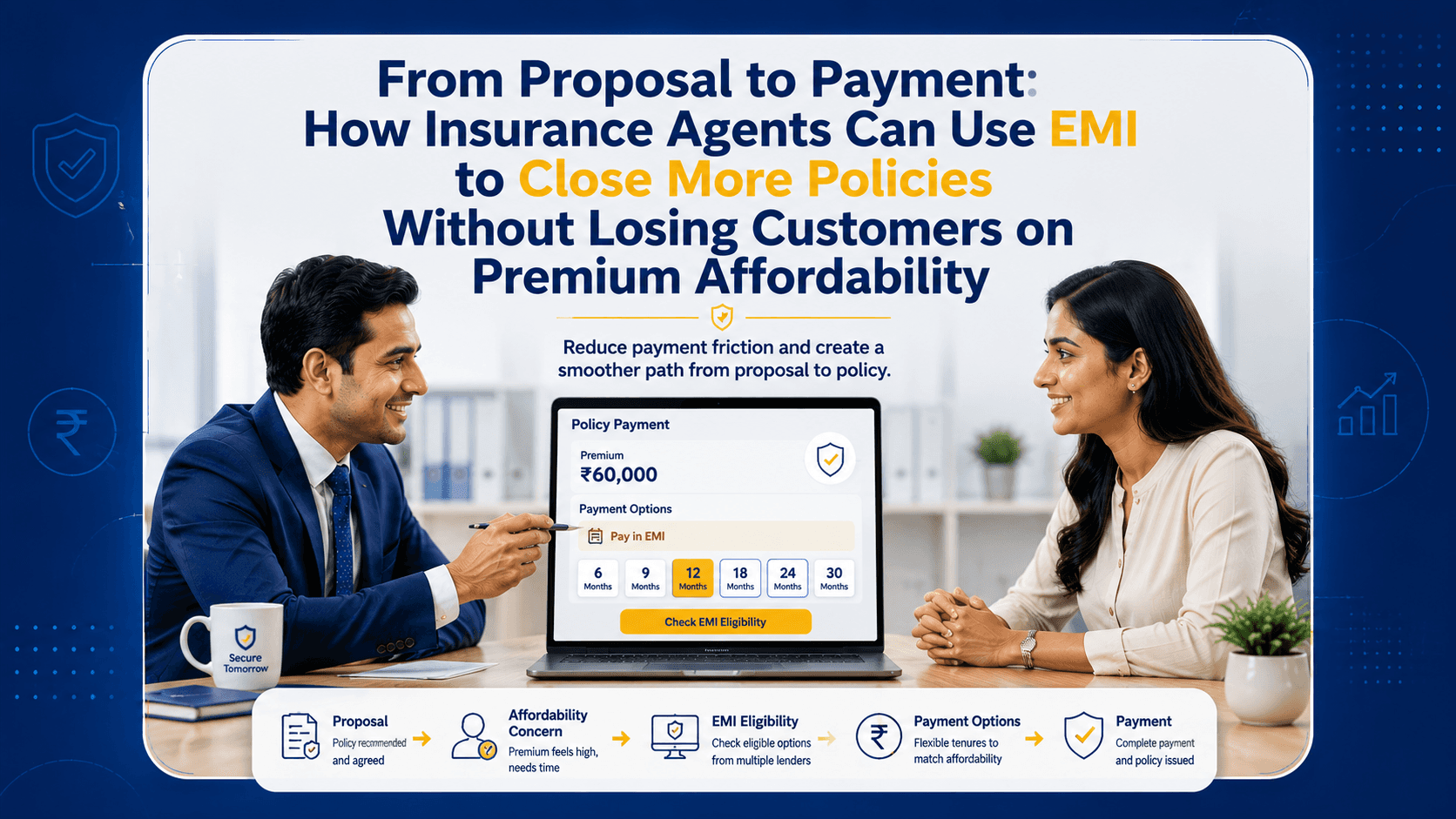
From Proposal to Payment: How Insurance Agents Can Use EMI to Close More Policies Without Losing Customers on Premium Affordability
Learn how insurance agents can use EMI as a payment option to address premium affordability concerns, reduce payment friction and create a smoother path from proposal to policy.

Why EMI Eligibility Checks Are Critical for Insurance Agents to Increase Policy Conversions
Why EMI Eligibility Checks Are Critical for Insurance Agents to Increase Policy Conversions

How Insurance Agents Can Sell More Policies by Offering EMI on Insurance Premium
Learn how EMI on insurance premiums can help insurance agents overcome affordability objections, improve policy conversions and potentially increase premium collection.

Multiple Lenders, One Form: How Insurance Agents Can Give Customers More EMI Options With a Single Eligibility Check
Learn how access to multiple lenders, banks and NBFCs through one simple eligibility check can help insurance agents simplify EMI conversations and give customers more payment options.