Why Premium Financing Should Start at Lead Capture


The Hidden Gap in Today’s Insurance Sales Funnel
Every insurance sales journey follows a familiar path: a lead is captured, a needs analysis is done, a product is recommended, a premium is quoted — and then, right at the finish line, the customer hesitates. Payment discussions begin. The sale slows down, and sometimes it’s lost entirely.
Insurers have spent years optimizing lead generation, digital onboarding, and policy issuance. Yet one variable is almost always left unexamined until the very end: affordability. The biggest unknown in the funnel isn’t customer interest — it’s whether the customer can comfortably pay for the coverage they actually need.
By the time affordability enters the conversation, the advisor has already invested time in needs analysis and product recommendation, and the customer has already anchored on a premium number that may feel out of reach. This is a structural gap in the insurance sales funnel — one that shows up repeatedly across health insurance and life insurance sales, and one that a smarter sequencing of premium financing can close.
Why Affordability Should Be Known Before Product Recommendation
Advisors are trained to qualify leads on age, income, occupation, health profile, and family needs. These inputs shape which product gets recommended. But there’s a missing dimension in that qualification: financing eligibility.
Today, most advisors don’t know, at the point of recommendation:
Whether the customer can finance the premium at all
Which lenders are likely to approve that specific customer
What monthly EMI the customer can comfortably manage
Bringing premium financing eligibility into lead qualification — alongside demographic and health data — changes the entire framing of the conversation. It turns affordability from a late-stage objection into an early-stage input that shapes which policy gets recommended in the first place.
Shift the Conversation from Premium Cost to Monthly Affordability
Framing matters enormously in insurance sales. Consider the difference between these two statements:
“This health insurance policy costs ₹60,000 annually.”
versus
“You’re eligible for premium financing, and this policy can be paid through affordable monthly EMIs.”
The first framing presents a large upfront number that can trigger sticker shock, especially for higher-value health insurance or life insurance policies. The second reframes the same cost as a manageable monthly commitment — before the customer has a chance to hesitate.
This isn’t just a sales technique. It’s a structural shift in how insurance premium on EMI gets positioned: not as a fallback offered when a customer balks at the price, but as a standing option built into the pitch from the start.
Why Checking Across Multiple NBFCs and Multiple Banks Matters
A single-lender approach to premium financing has an inherent ceiling. Lending policies, risk appetites, and approval criteria vary significantly across institutions — a customer declined by one NBFC may be readily approved by another bank or NBFC with different underwriting norms.
Insurers relying on just one financing partner are, in effect, capping their own conversion potential. Checking eligibility across multiple NBFCs and multiple banks simultaneously changes the economics of the funnel:
Higher approval rates — a decline from one lender doesn’t end the customer’s financing option
Fewer unnecessary rejections — the system routes to whichever lender’s criteria the customer actually fits
Broader financing access — more customer segments become eligible for some form of financing
Better customer experience — one check, multiple possible outcomes, instead of a single pass/fail gate
For CXOs evaluating a multi-lender eligibility platform, this is the core lever: approval rate is a function of how many credit models a customer is checked against, not just how good any single lender’s underwriting is.
One Platform for All EMI Payment Options Simplifies the Journey
The natural objection to “check multiple lenders” is integration complexity — building and maintaining individual connections to several NBFCs and banks is operationally heavy for both technology and sales teams.
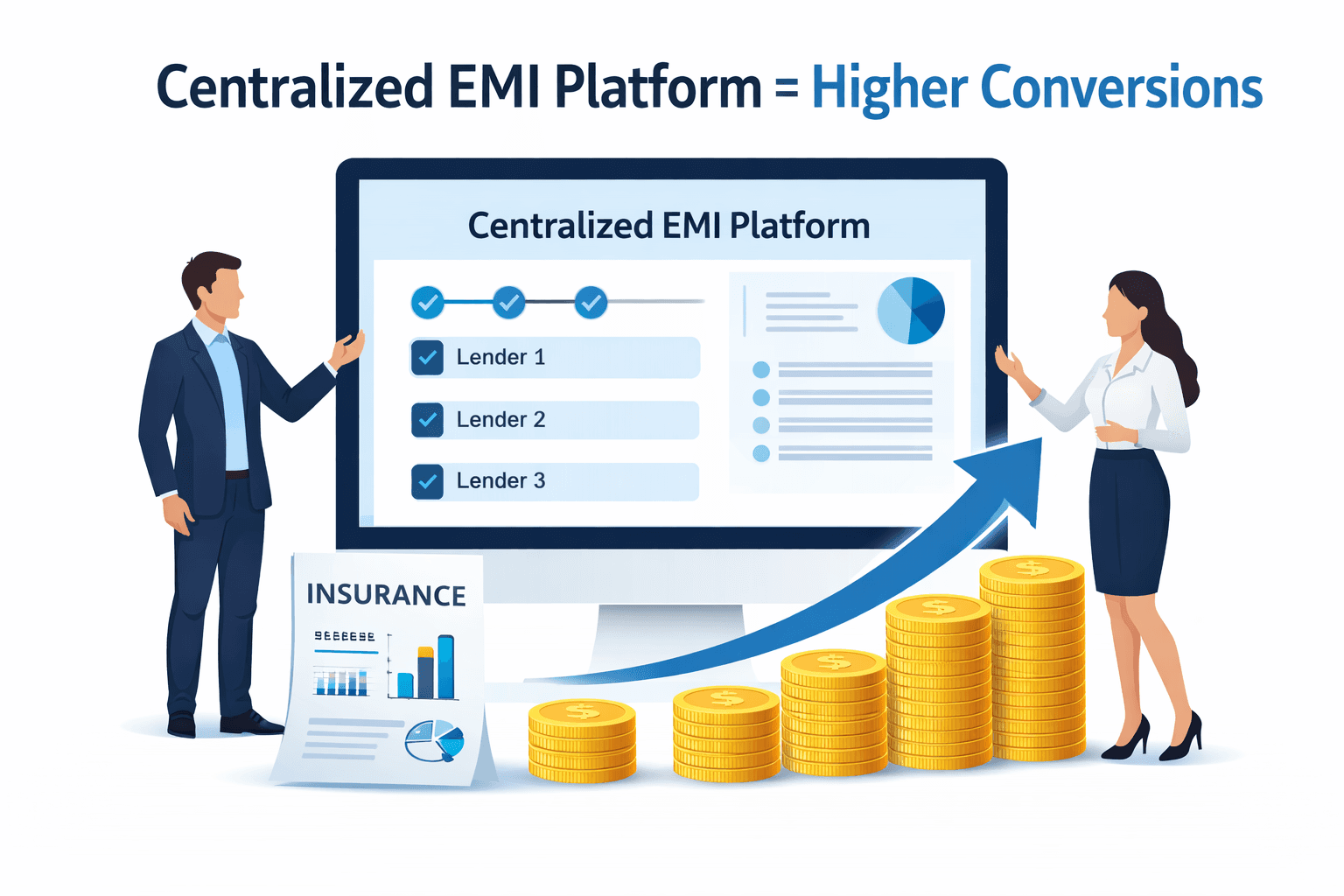
This is where a single platform for all EMI payment options becomes the practical answer. Rather than insurers integrating with each lender independently, one platform layer can provide:
A single, unified customer journey regardless of which lender ultimately approves
One eligibility check that fans out across multiple NBFCs and banks
Access to pre-approved EMI options, credit card EMI, and other digital lending routes
Multiple repayment tenure options presented in one place
For advisors, this collapses what would otherwise be a fragmented, lender-by-lender process into a single, consistent workflow. For customers, it means one journey instead of being redirected across multiple financing portals.
How Early Premium Financing Improves Every Stage of the Sales Funnel
The impact of moving financing eligibility to lead capture isn’t confined to the payment step — it changes the character of every stage that follows.
Sales Funnel Stage | Traditional Approach | Eligibility-First Approach |
|---|---|---|
Lead Capture | Customer details collected | Customer details + financing eligibility checked |
Lead Qualification | Based on demographics | Based on affordability and financing eligibility |
Product Recommendation | Premium-first | Affordability-first |
Advisor Conversation | Payment discussed later | EMI options available from Day 1 |
Objection Handling | Reactive | Proactive |
Checkout | Financing introduced at payment | Financing already established |
Higher drop-offs | Faster, smoother conversions |
The underlying shift is simple to state but significant in effect: premium financing stops being just a payment solution and becomes a sales qualification tool. It informs which leads to prioritize, which products to recommend, and how advisors frame the conversation — long before checkout is even in view.
Business Benefits for Insurance CXOs
For CXOs — whether the mandate sits with distribution, sales, digital, or agency leadership — an eligibility-first approach to premium financing translates into measurable outcomes across the funnel:
Higher lead-to-policy conversion
Increased approval rates through multi-lender access
Improved advisor productivity, with fewer stalled conversations at the payment stage
Lower payment-stage drop-offs
Higher average premium ticket size, as affordability constraints ease
Better lead prioritization, using financing eligibility as a qualification signal
Faster policy issuance
Stronger customer experience
Increased overall premium collections
Improved ROI on lead generation spend, since fewer qualified leads are lost to affordability friction
These aren’t benefits confined to one department. Distribution leaders get better-qualified leads, sales leaders get higher advisor productivity, digital leaders get a smoother funnel to optimize, and the CFO’s office sees the downstream effect in collections and ticket size.
Health and Life Insurance Benefit the Most
Affordability friction scales with premium size, which makes health insurance and life insurance — typically the higher-value policy categories — the segments where eligibility-first financing has the most leverage.
Offering health insurance on EMI and life insurance on EMI through premium financing allows customers to:
Access more comprehensive coverage instead of down-selecting to a cheaper, thinner policy
Preserve cash flow rather than depleting savings for an annual premium
Pay comfortably over time instead of treating the premium as a single large decision
For insurers, the effect compounds: customers who might have settled for lower coverage — or walked away entirely — convert into stronger policies with larger premium values, simply because the payment structure matched their cash flow reality.
The Future of Insurance Sales Is Eligibility-First
The insurance industry has already optimized lead generation, digital onboarding, and policy issuance extensively. The next meaningful gain isn’t in any of those stages individually — it’s in making affordability visible at the very beginning of the journey, before it has a chance to surface as an objection.
Checking premium financing eligibility across multiple NBFCs and multiple banks, delivered through a single platform for all EMI payment options, lets insurers remove affordability barriers before they ever become sales friction.
Conclusion
Insurance leaders often focus their conversion efforts on the end of the journey — checkout flows, payment reminders, last-mile nudges. But the biggest opportunity may actually sit at the very beginning.
By introducing premium financing at the lead capture stage, insurers can understand customer affordability early, personalize recommendations accordingly, prioritize high-potential leads more accurately, and offer insurance premium on EMI through multiple NBFCs and multiple banks — all from a single platform for all EMI payment options.
For CXOs, this isn’t just a payment innovation. It’s a strategic lever for improving conversion rates, advisor productivity, customer experience, and sustainable premium growth across both health and life insurance.
Related reads

Premium Financing: The Missing Stage in India's Insurance Sales Funnel
Affordability, not intent, is why insurers lose sales. See how premium financing turns EMI eligibility into a formal funnel stage that lifts sum assured, tenure, and conversions.

Insurance Premium Financing in India: How EMI Increases Policy Conversions for Insurers
Learn how insurance premium financing and zero down payment EMI help insurers increase policy conversions, improve average ticket size, and accelerate revenue growth without increasing acquisition costs.

How Checking Customer EMI Eligibility Before Creating a Proposal Can Help Insurance Agents Improve Conversions
Learn how checking EMI eligibility early can help insurance agents identify affordability concerns, reduce late-stage payment objections and create a smoother path from proposal to policy.
How a Single EMI Platform Helps Insurance Sales Managers Improve Conversions and Reduce Policy Drop-Off
Discover how a centralized EMI platform with multiple payment options helps insurance sales managers increase policy conversions, reduce drop-offs, and accelerate team target achievement.