Quarterly and Half-Yearly Premium Payments vs Premium Financing: What Insurers Should Know

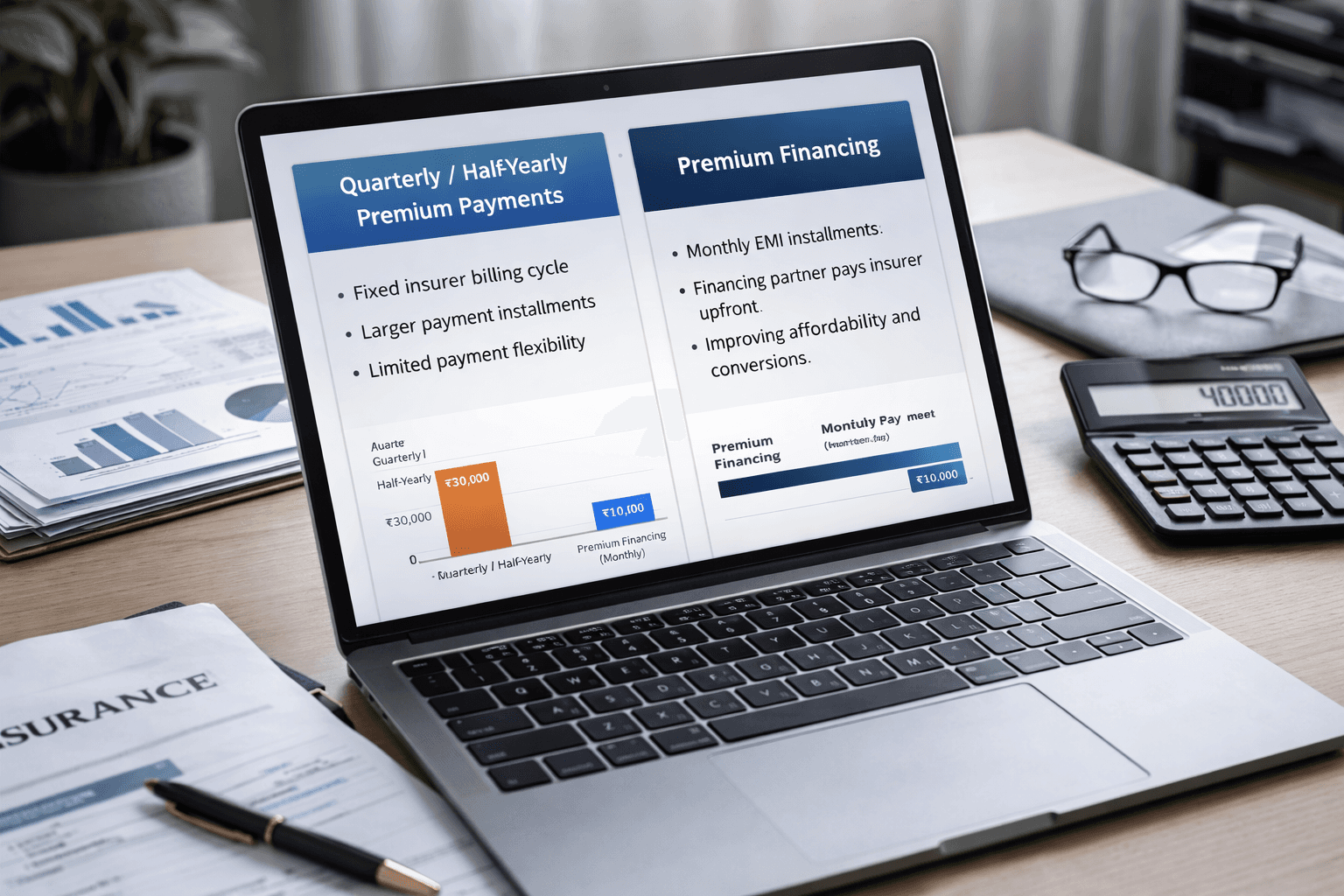
Insurance companies have traditionally offered multiple premium payment frequencies to make policies easier to purchase.
Customers can often choose between annual, half-yearly, or quarterly premium payments depending on the insurer and policy structure.
These options are designed to reduce the burden of paying the entire premium upfront.
However, while installment frequency improves flexibility, it does not always solve the underlying affordability challenge faced by many customers.
This is where premium financing for insurance is beginning to play an important role in modern insurance distribution.
Understanding the difference between payment frequency and financing is becoming increasingly important for insurers and sales leaders focused on improving policy conversions.
The Traditional Approach: Quarterly and Half-Yearly Premium Payments
Most insurance companies provide customers with the option to split the annual premium into smaller payments.
Common payment structures include:
Annual premium payment
Half-yearly premium payment
Quarterly premium payment
In this structure, the insurer simply divides the annual premium into multiple payments across the policy year.
For example, a policy with a ₹40,000 annual premium may be offered as:
₹40,000 yearly
₹20,000 half-yearly
₹10,000 quarterly
This approach helps reduce the immediate payment burden for customers.
However, the total premium is still tied to the insurer’s billing cycle, and the payment flexibility remains limited.
The Limitation of Payment Frequency
While quarterly and half-yearly payments provide some flexibility, they do not fully solve affordability challenges.
Customers still face several constraints:
1. Large upfront payments still exist
Even quarterly payments may remain large for high-value policies.
For example, a ₹1,20,000 annual premium still becomes ₹30,000 per quarter.
2. Payment schedules are fixed
Customers must follow the insurer’s billing cycle rather than choosing a repayment plan that fits their financial situation.
3. Conversion decisions still depend on immediate affordability
If customers cannot manage the first premium installment, the policy may not convert.
This creates friction at the checkout stage of the insurance purchase journey.
How Premium Financing Works
Premium financing introduces a different approach to solving insurance affordability.
Instead of adjusting payment frequency within the insurer’s billing structure, financing allows customers to spread the premium into smaller, structured installments through a financing partner.
In this model:
The financing provider pays the full premium to the insurer upfront.
The customer repays the amount through monthly installments.
This creates a smoother payment experience for customers while ensuring that insurers receive the premium immediately.
Premium Financing vs Quarterly Premium Payments
The key difference lies in how payment flexibility is structured.
Quarterly or half-yearly premiums are simply billing schedules, while premium financing introduces structured repayment options.
Payment Method | Structure |
|---|---|
Quarterly / Half-Yearly Premium | Insurer divides the premium across fixed billing cycles |
Premium Financing | Financing partner pays the insurer upfront while customers repay in smaller installments |
This distinction can significantly influence policy conversions, particularly for high-value policies.
Why Premium Financing Improves Policy Affordability
Premium financing improves affordability in several ways.
1. Smaller installment amounts
Instead of quarterly payments, customers may repay premiums through monthly installments.
This reduces the psychological and financial barrier at checkout.
2. Immediate policy issuance
Insurers receive the premium upfront, allowing policies to be issued without waiting for multiple payments.
3. Better policy accessibility
Customers who may not afford large upfront premiums can still purchase adequate coverage.
This improves policy adoption across customer segments.
Impact on Insurance Sales Conversions
For insurance sales teams, the difference between payment frequency and financing can be significant.
When customers are offered flexible EMI payment options, sales conversations become easier.
Agents can focus on policy value and coverage rather than negotiating premium affordability.
This often results in:
higher policy conversions
larger ticket sizes
improved customer experience
Premium financing therefore acts not just as a payment option, but as a conversion infrastructure for insurance distribution.
Why Insurers Are Exploring Premium Financing Platforms
As insurance premiums increase with higher coverage and inflation-adjusted pricing, affordability becomes a critical factor in policy adoption.
Modern insurers are increasingly exploring premium financing platforms that allow customers to pay premiums through structured installment plans.
These platforms integrate with insurer payment journeys and provide customers with flexible repayment options at the point of purchase.
For insurers focused on improving conversion rates and expanding policy accessibility, premium financing offers a scalable solution.
Conclusion
Quarterly and half-yearly premium payments have long helped insurers introduce flexibility into premium billing.
However, as policy values increase and customer expectations evolve, payment frequency alone may not fully address affordability challenges.
Premium financing for insurance provides a more flexible approach by allowing customers to repay premiums in smaller installments while insurers receive the full premium upfront.
For insurance companies seeking to improve policy conversions and expand coverage accessibility, understanding this difference is becoming increasingly important.
Related reads

How Premium Financing Helps Maximize Policy Sales and How It Really Works
Affordability, not lack of intent, is why customers underbuy insurance. Here's what premium financing actually is, how it works end-to-end, and how insurers can use it to convert more policies at higher sum assured.

Insurance Premium Financing in India: How EMI Increases Policy Conversions for Insurers
Learn how insurance premium financing and zero down payment EMI help insurers increase policy conversions, improve average ticket size, and accelerate revenue growth without increasing acquisition costs.

Loan to Pay Insurance Premium on EMI: How Premium Financing Helps Insurers Sell More Policies
How loan to pay insurance premium on EMI is turning premium financing into a strategic growth lever for insurers, agents, and distribution leaders.

Understanding Premium Financing Platforms in India: A 2026 Guide for Insurance Companies
A comprehensive guide for insurers evaluating premium financing platforms in India, covering financing models, approval structures, and how centralized platforms improve insurance conversions.